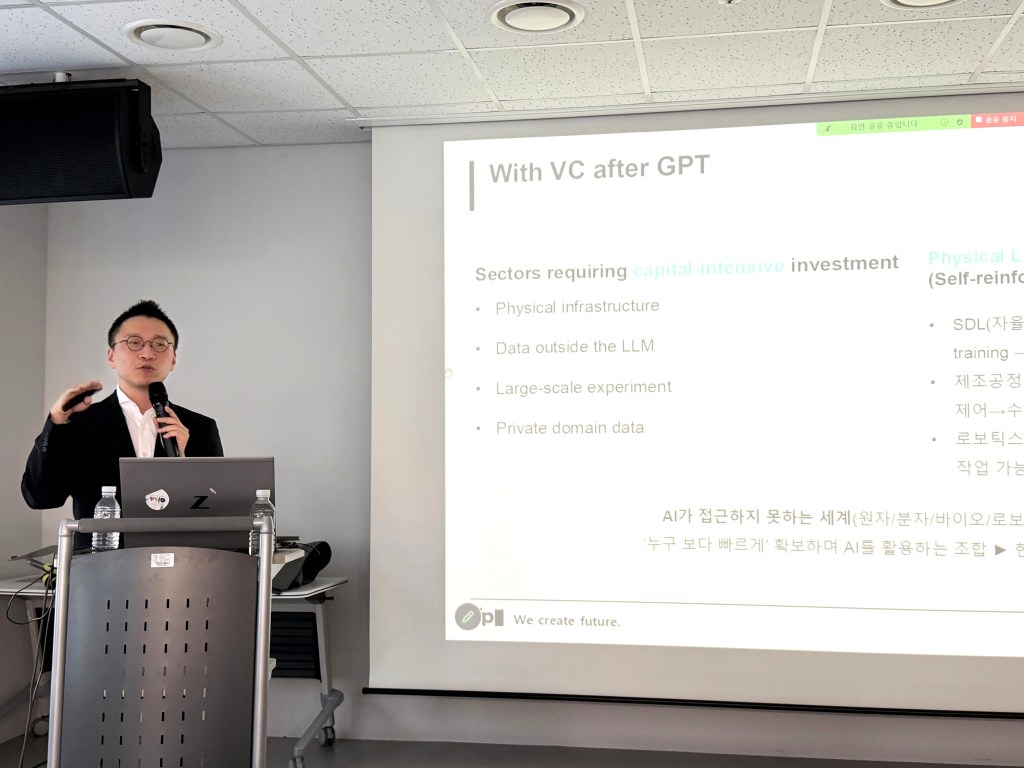
Johnny JW Choi, Managing Director at FuturePlay, explains growth strategies for deep tech startups and changes in the AI investment market at the Distinguished Lecture Series on April 7. [Source: NAIRL]
As the AI paradigm shifts from standalone model performance competition to integration with real-world industrial environments, FuturePlay—a leading domestic deep tech accelerator and venture capital (VC) firm—shared deep insights that lab-based startups must build a practical ‘business moat’ that goes beyond academic achievements.
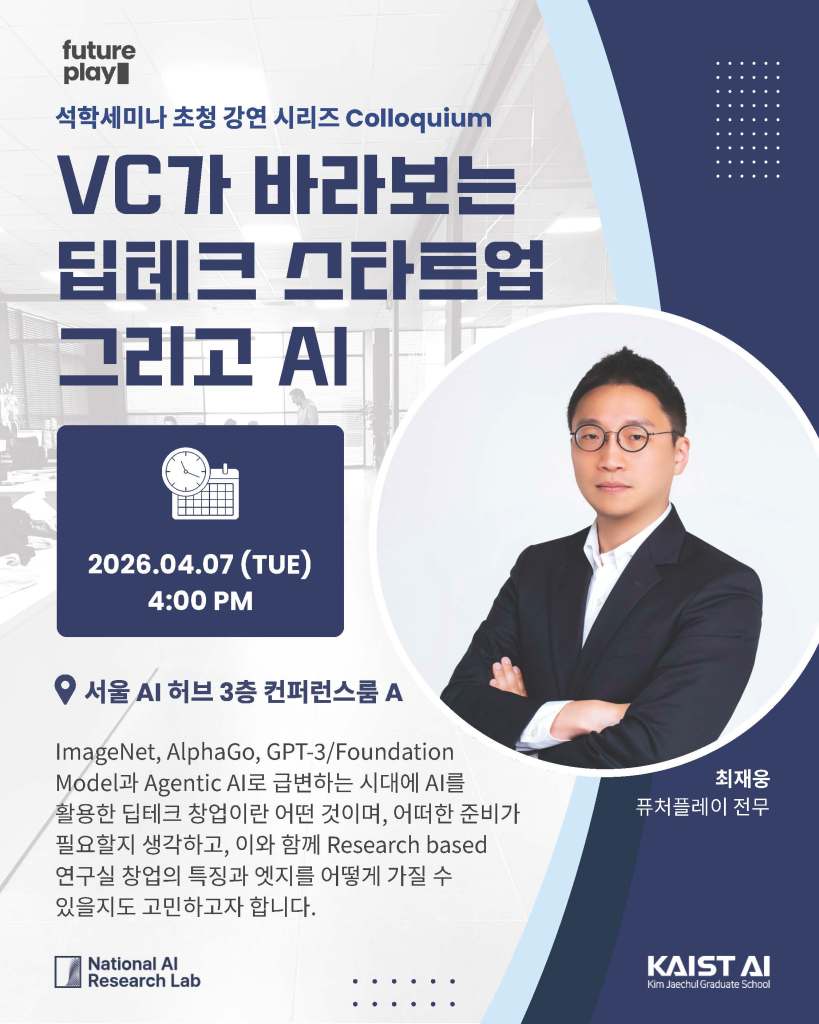
On April 7th, the National AI Research Lab (NAIRL) and KAIST’s Kim Jaechul Graduate School of AI co-hosted a distinguished lecture featuring Johnny JW Choi, Managing Director at FuturePlay, at the Seoul AI Hub. The lecture was themed “Deep Tech Startups and AI from a VC’s Perspective.”
Reflecting the intense interest in the intersection of AI research and entrepreneurship, the event drew approximately 300 attendees. While 120 KAIST students and researchers participated on-site at the Seoul AI Hub, another 180 joined online—including representatives from partner organizations—further fueling the enthusiasm for the session.
[Source: FuturePlay]
Choi, an engineer-turned-investor, sharply pointed out the ‘Lab-based Startup Dilemma’ commonly faced by academic entrepreneurs. He emphasized that the world’s best technology does not necessarily translate into the world’s best product, diagnosing that the era of merely providing technical features is fading. “In an era where intelligence is commoditized, ‘domain expertise’ in a specific industry and ‘real-world data’—rather than the standalone capability of a model—will be the core engines driving J-curve and I-curve growth,” he projected.
In particular, he presented ‘Physical AI’ and ‘Self-driving Labs’ as specific examples of high-value investment sectors. He explained that building a loop where AI integrates with physical infrastructure to autonomously generate hypotheses, conduct experiments, and accumulate data will become a powerful moat in the post-GPT era. He stressed the importance of building systems that take responsibility for the end-to-end completion of actual tasks, going beyond services that merely provide plausible answers.
The presentation was followed by a dynamic Q&A session where KAIST students posed a series of sharp questions. Attendees inquired about team-building strategies and the transition from lab-scale technology to commercial-scale processes. Choi responded generously, sharing practical entrepreneurial advice alongside vivid perspectives from the VC industry.
NAIRL plans to continue taking the lead in fostering an ecosystem where domestic researchers can create innovative business value based on cutting-edge technology, through ongoing exchanges with global-level investors and industry leaders.
Official poster for the Distinguished Lecture Series featuring Johnny JW Choi from FuturePlay, held on April 7 at the Seoul AI Hub. [Source: NAIRL]
The Heart of AI Innovation in Korea
108, Taebong-ro, Seocho-gu, Seoul 06764, Republic of Korea
56 Yangjae-daero 12-gil, Seocho-gu, Seoul 06804, Republic of Korea