
Seminar
Computing with Neural Manifolds: A Multi-Scale Framework
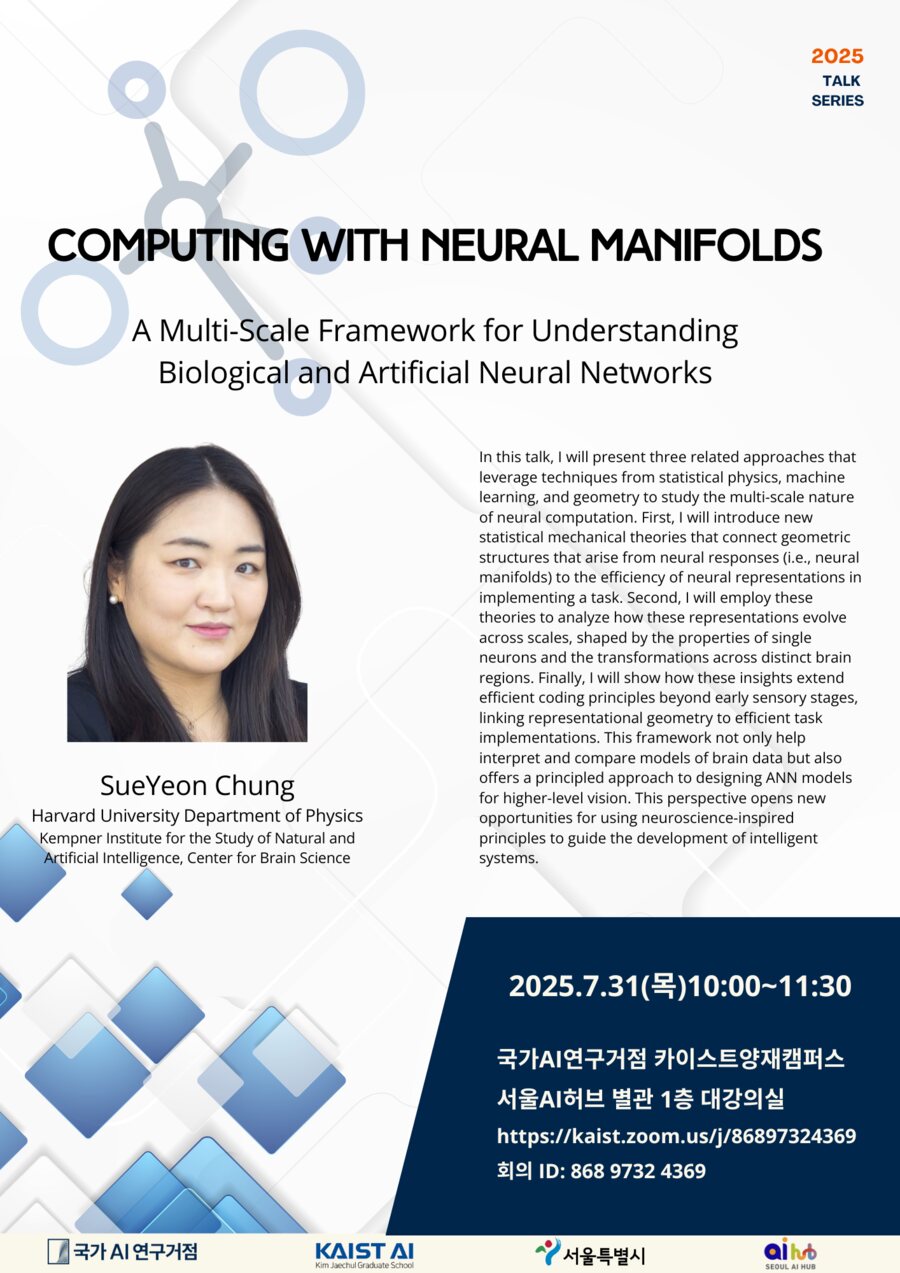
Recent breakthroughs in experimental neuroscience and machine learning have opened new frontiers in understanding the computational principles governing neural circuits and artificial neural networks. Both biological and artificial systems exhibit orchestrated information processing across multiple scales — from individual neurons to the emergent phenomena of cognition and task functions. At the mesoscopic scale, the structures of neuron-population activities manifest as neural representations, and neural computation can be viewed as a series of transformations of these representations.
This talk presents three related approaches leveraging statistical physics, machine learning, and geometry. First, statistical-mechanical theories that connect geometric structures of neural responses (neural manifolds) to the efficiency of neural representations. Second, how representations evolve across scales, shaped by single-neuron properties and transformations across brain regions. Finally, how these insights extend efficient-coding principles beyond early sensory stages, linking representational geometry to efficient task implementation — offering a principled approach to designing ANN models for higher-level vision.
Speaker
SueYeon Chung is affiliated with Harvard University’s Department of Physics, the Kempner Institute, and the Center for Brain Science.