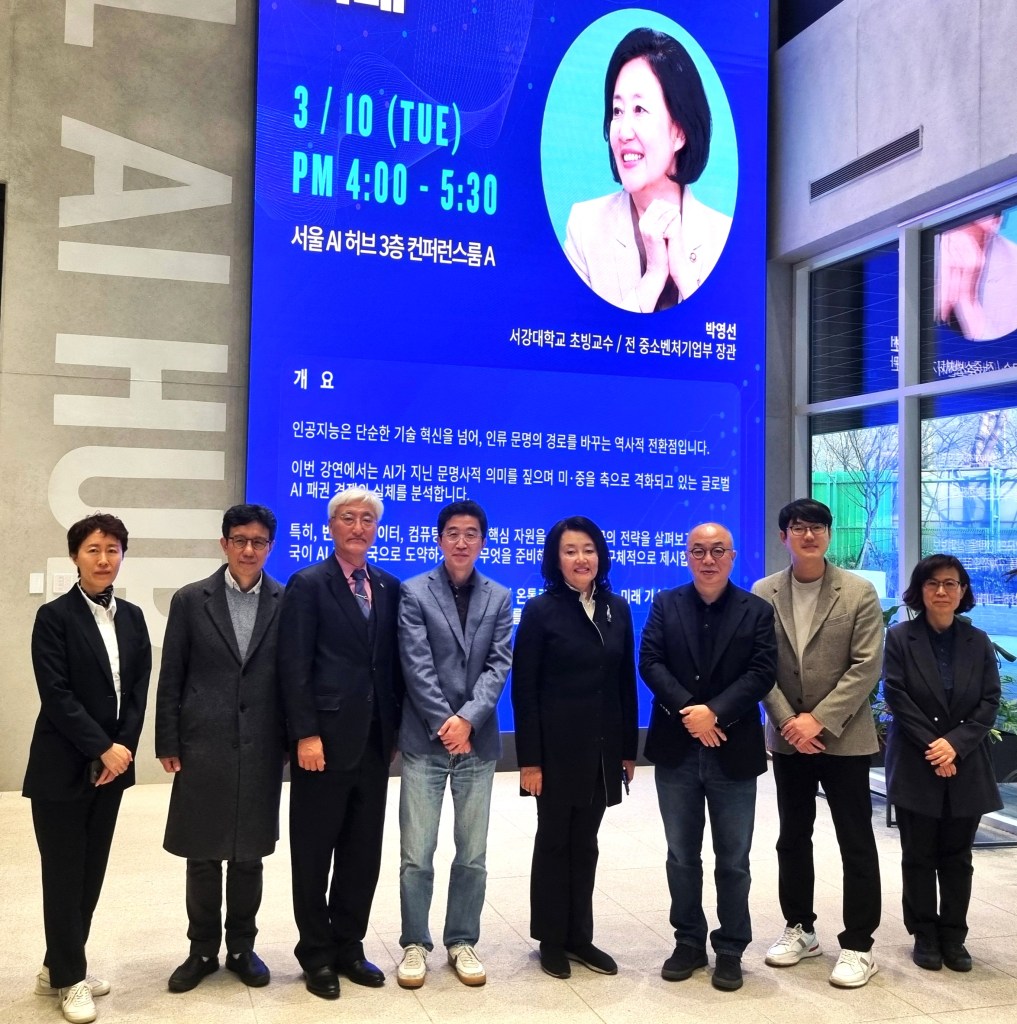
Group photo at the NAIRL–KAIST AI Monthly Distinguished Lecture Series, held at KAIST's Kim Jaechul Graduate School of AI on March 10. [Source: NAIRL]
Former Minister of SMEs and Startups Park Young-sun has laid out an independent national survival strategy for South Korea to emerge as one of the world’s top three AI powers—what she calls “AI G3″—amid an intensifying global race for technological supremacy.
Speaking on March 10 at the Monthly Distinguished Lecture Series co-hosted by KAIST’s Kim Jaechul Graduate School of AI and the National AI Research Lab (NAIRL), Park presented her vision for securing Korea’s leadership in the next-generation AI ecosystem. The event drew approximately 300 attendees—120 on-site at KAIST, 130 via Zoom, and 25 executives and staff from NAIRL partner organizations—underscoring broad interest in charting Korea’s AI future.
Park opened by framing the advent of AI as the third watershed moment in the 13.8-billion-year history of the universe—following the Big Bang and the emergence of life. She singled out KAIST’s research community as central protagonists of this transformation, describing the graduate students and researchers currently in training as irreplaceable national assets who will propel Korea into the AI G3.
Former Minister Park stresses the importance of building a "Korean Ontology Platform" as a core strategy for Korea's AI G3 ambitions at the Distinguished Lecture Series on March 10. [Source=NAIRL]
Her analysis then turned to the geopolitical landscape. The United States, she noted, is pushing to establish global standards for AI agents as early as next year while consolidating a pro-U.S. bloc of allied nations. China, meanwhile, is leveraging state capitalism and massive capital deployment to dominate the open-source ecosystem through initiatives like DeepSeek, while racing to lead the emerging era of physical AI powered by intelligent robotics.
Citing warnings from Palantir CEO Alex Karp, Park highlighted the link between ideological bias and technological sovereignty. She pointed to how large language models such as Claude and Grok reflect divergent value systems on sensitive issues—a phenomenon that, she argued, risks reducing nations without their own technical standards to the status of “digital colonies.”
Park identified the construction of a dedicated national AI supercomputing infrastructure as the first critical priority. Drawing a historical parallel to how computing power proved decisive in conflicts from Vietnam to the Gulf War, she called on Korea to target a world top-10 computing environment that gives researchers the room to operate at full capacity.
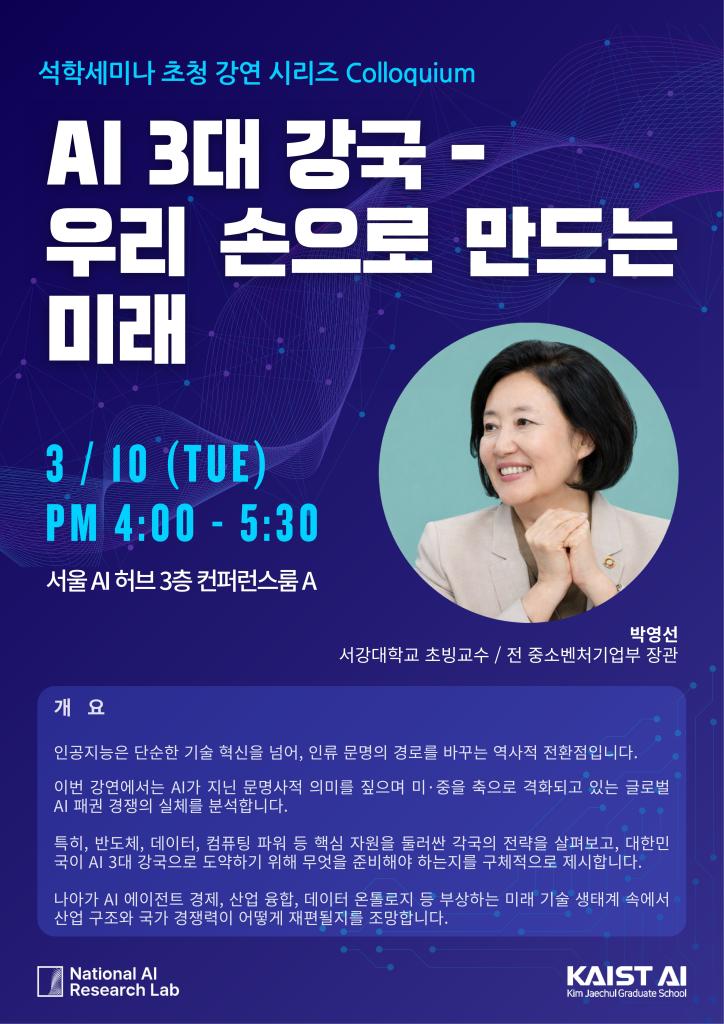
Official poster for the Distinguished Lecture Series featuring Former Minister Park Young-sun, co-hosted by KAIST's Kim Jaechul Graduate School of AI and the National AI Research Lab (NAIRL). [Source=NAIRL]
As Korea’s answer to Taiwan’s AI factory strategy, Park pointed to the development of a Korean ontology platform and a manufacturing-specialized data ecosystem. She praised the Korean manufacturing data platform pioneered under Kim Heung-nam, former president of the Electronics and Telecommunications Research Institute (ETRI), and argued that Korea must upgrade its fragmented manufacturing data into an ontology framework—one where AI autonomously identifies and learns from cross-domain relationships—to preserve its competitive edge.
Park contrasted the clear strategic direction adopted by other advanced economies—Taiwan in manufacturing, Japan in science—with Korea’s lack of a comparable national focus, urging the country to launch cross-ministerial mega-projects and rapidly define a distinctive vertical AI blueprint.
She made clear that NAIRL and Korea’s broader AI innovation ecosystem represent the core engine for driving these ambitions. “The real blueprint for an AI G3 must be completed right here,” she said, calling on researchers to step beyond technical development and serve as architects of national survival strategy.
“You, the KAIST research community, are the ones who will open the historic door of the great AI transformation,” Park said. “AI G3 is not something others will build for us—it is something you will build.”
The Heart of AI Innovation in Korea
108, Taebong-ro, Seocho-gu, Seoul 06764, Republic of Korea
56 Yangjae-daero 12-gil, Seocho-gu, Seoul 06804, Republic of Korea