

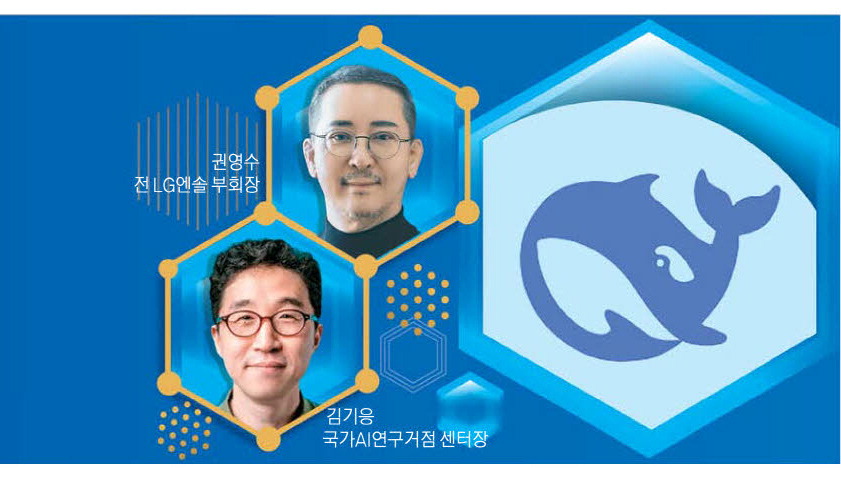
Maeil Business Newspaper has decided to spotlight the current crisis facing the Korean economy from four perspectives: the growth of the AI industry, the trade war sparked by Donald Trump, China’s technological ascent, and South Korea’s lack of new growth engines. To this end, it held an on-site roundtable with Korea’s top experts: Kwon Young‑soo (former Vice Chairman of LG Energy Solution), Kim Ki‑eung (Center Director of the National AI Research Hub and KAIST Distinguished Professor), Song Seung‑heon (Managing Partner of McKinsey Korea), and Jin Dae‑je (Chairman of Skylake Investment) (in alphabetical order).
Since the Korean War, the Korean economy built an industrial structure shifting from light industry to heavy-chemical industry and for over 30 years rode the wave of globalization following the collapse of the Soviet Union. However, that growth formula is no longer effective. In the new hegemony war between the United States and China centered around cutting-edge industries like artificial intelligence (AI) and quantum computing, South Korea’s position is narrowing. Korea had responded under the Biden Administration by inserting itself into the U.S.-led supply chain strategy when asked whether it belonged to the U.S. or China. But the Trump administration has made clear that even allies must share economic benefits only if the U.S. allows it. In the meantime, China has raised its technological prowess in high-end industries to a level hard for Korea to challenge, posing a comprehensive threat to Korean industry.
China’s low-cost, high-performance generative AI model, DeepSeek, is causing tectonic shifts in an AI industry long led by the U.S. What is the driving force behind China’s technological ascent?
▷ Chairman Jin: The government’s deliberate plans and strategy can be cited. China established an ambitious national strategy ten years ago to become a great manufacturing power by 2025—and has made that real. China not only aimed to produce low-cost, high-quality products across many sectors and dominate global manufacturing, but also to internalize the supply of key parts and materials. Over the past decade, China’s central and local governments have supported enterprises with subsidies across all fronts. That strategy is the driving force behind the nation’s technological ascent.
▷ Former Vice Chairman Kwon: We must painfully accept the fact that China is building world-class competitiveness in future industries such as AI, secondary batteries, and electric vehicles, creating its own success stories. What lies at the core of this technological leap? Do you know how many research and development (R&D) personnel BYD, a Chinese electric-vehicle company, employs? It’s 100,000 (whereas Hyundai Motor Company and Kia Corporation are around 14,000). Indeed, it is hard to say BYD grew solely because of government subsidies. China now has massive global market profits, nurtures many high-end industry talents, and has rooted an innovative entrepreneurial culture. The competitiveness of Chinese high-tech companies lies in bold investment and persistent R&D.
▷ Managing Partner Song: A vast ecosystem of high-tech talent has also become the momentum behind China’s rise. Fundamentally an economy grows based on capital, labor, and productivity, but China’s capital and labor are facing constraints. First, its debt-to-GDP ratio is high, restricting capital. Its population is also rapidly aging and has declined for three consecutive years, so boosting productivity was China’s only answer. For that, technological innovation was necessary, and the Chinese government launched mid- to long-term AI expert training programmes in a state of urgency. Since the 2018 “University AI Innovation Action Plan”, the number of university AI-related departments in China has exceeded 500. In 2024 alone, undergraduate enrolment in AI-related departments surpassed 40,000. Add to that the generous support that Chinese companies are known for when recruiting overseas top talent, and you have a high-tech talent ecosystem that’s been formed.
▷ Director Kim: China’s renowned AI researcher Kai‑Fu Lee cited the talent pool as one reason China has no choice but to surpass the United States in AI. AI model development is less about creative innovation and more about brute-force experimentation, and China’s rich pool of low-wage, lower-level software developers becomes a strength. Add to that data and intellectual-property regulations that are looser than in advanced countries, and start-up culture that is far more aggressive than in the U.S. Lee said “If data is the oil of the future, China is the new Saudi Arabia” — given this context his remark is understandable.
Is it possible that DeepSeek’s achievements are overhyped, and in particular that its stated usage cost reductions are exaggerated? Could China’s technological strength be overstated?
▷ Managing Partner Song: It’s safe to say China’s AI technology has already reached the “next level”. The private companies that led China’s high-tech development pushed the agenda. The tech-hub of Hangzhou, dubbed China’s Silicon Valley, and the so-called “Six Little Dragons” companies leading it achieved technological innovation independently and now compete with global big tech companies on equal footing.
▷ Director Kim: While there is debate over DeepSeek’s development cost, the AI academic community has seen many excellent Chinese papers for more than a decade. In terms of technological capability we can say China is on par with the U.S. We must evaluate China’s technological ascent without prejudice. We must accept that not only in quantity but also in quality, China is ahead of our country.
[Reporters: O Su-hyun / Choo Dong-hoon / Ko Jae-won / Hong Soon-bin]
