

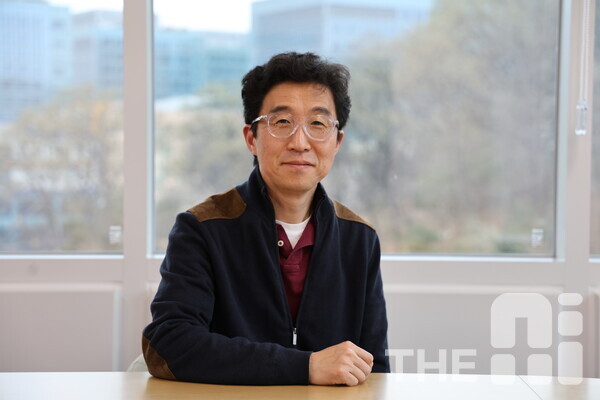
“An era is coming when AI robots will collaborate and interact with one another.”
“A fundamental transformation is needed… we still lack the capability to build our own AI infrastructure.”
“If we rely solely on foreign models, we will lose leadership in AI.”
“We are entering an era where multiple AIs must cooperate — the next step after Physical AI is Multi-Agent AI.”
“An era is coming when not just one artificial intelligence (AI), but multiple AIs will need to collaborate. The next stage after Physical AI is Multi-Agent AI,” said Professor Kim Ki-eung, Director of the National AI Research Hub and Professor at the Kim Jae-chul Graduate School of AI at KAIST.
He explained that AI technology is evolving from “Physical AI,” which interacts with the physical world, toward “Multi-Agent AI,” in which AI robots interact and cooperate with one another. If the current focus has been on creating AIs that can act like humans, the next key challenge will be enabling AIs to collaborate with each other.
Professor Kim elaborated, “The goal is to make agents infer each other’s intentions and situations so they can cooperate. We are moving toward an era of reasoning-based collaborative AI that can ‘read the room,’ understand context, and offer help — much like humans do.” He added, “AI must be able to perceive situations and the actions of others and assist accordingly. Even a child can easily judge when someone needs help, but AI has yet to reach that level.”
Currently, Professor Kim leads the National AI Research Hub Center, a consortium centered around KAIST and joined by research teams from Korea University, Yonsei University, and POSTECH. It also partners with 12 international institutions — including Stanford University, Cornell University, New York University, and the University of Toronto — as well as five major corporations such as POSCO and LG, and seven startups including 42Maru and Enzy. The center was established to create a national AI research ecosystem and to elevate Korea into the world’s top three AI powers (the so-called “AI G3”).
Modeled after the UK’s Alan Turing Institute, the hub aims to build a university-centered ecosystem for foundational AI research. A total of 94.6 billion KRW (approximately USD 70 million) is being invested over five years, including 44 billion KRW (USD 33 million) in government funding. The focus is on securing long-term, fundamental technologies rather than chasing short-term results.
Rather than developing large-scale AI models, the center is focusing on fundamental research areas such as surpassing neural scaling laws and developing robot foundation models. Professor Kim noted that the center’s budget is insufficient to build massive models like DeepSeek, explaining, “Training even a single ultra-large model costs more than our entire center’s annual budget. For now, we are prioritizing strengthening academic research capabilities and securing core foundational technologies.”
He also offered a candid assessment of the domestic AI ecosystem: “Korea is a latecomer in almost every AI field — from autonomous driving to smart factories. Even though we’re considered a manufacturing powerhouse, our ability to transition into AI-driven industries is still weak.”
Professor Kim also pointed to shortcomings in AI infrastructure: “Not only do we lack sufficient AI infrastructure, but we also lack the technical capacity to build it ourselves. Historically, many Korean companies have maintained closed systems and avoided cloud-based operations, which has limited our development of cloud computing — the foundation of AI infrastructure.”
He emphasized, “Now is the time for a comprehensive transformation to secure leadership in AI technology.”

Q. Which AI technologies do you expect will gain attention in the next five years?
“Following ‘Physical AI,’ the next core technology will be ‘Multi-Agent AI.’ So far, the goal has been to develop a single AI that behaves like a human in the physical world. But going forward, multiple AIs will collaborate to solve complex problems together. Multi-Agent AI will evolve to allow different agents to infer intentions and situations and cooperate even under limited communication conditions. It will advance toward realizing reasoning-based collaborative AI that can read social cues, understand context, and assist others — just like humans.”
Q. How might Multi-Agent AI affect our lives?
“It will be used across many domains. In the past, we talked about ‘AI assistants,’ but now we use terms like ‘co-pilot’ or ‘co-scientist.’ AI that works alongside humans as equals will become the standard.”
Q. What research are you conducting in the field of Multi-Agent AI?
“We are studying the cooperation structure of multi-agents using game theory. The focus is on developing algorithms that strengthen the agents’ ability to cooperate. The key is to train AIs to infer each other’s intentions through actions rather than direct communication within given rules.
For example, we’re teaching AIs how to cooperate in scenarios similar to team-based card games, where explicit information sharing isn’t possible. As the number of agents increases, communication volume grows exponentially, so it’s crucial to design systems that can still cooperate efficiently under limited communication.”
Q. Is the National AI Research Hub Center also conducting research on Multi-Agent AI?
“Yes. Among the participating professors in the National AI Research Hub, Professor Sung Young-chul of KAIST has long studied multi-agent systems. He’s applying the concept to real-time traffic signal control, aiming to optimize the balance between efficiency and fairness in managing vehicle flow.
In traffic management, it’s not enough to simply maximize throughput — fairness in waiting time also matters. If we pursue efficiency alone, it might favor vehicles that can pass quickly, which would be unfair to others. His research seeks to find the optimal balance between efficiency and fairness using AI algorithms.”
Q. Why is the National AI Research Hub Center important?
“Korean AI researchers are individually outstanding, but there have been few opportunities to bring their strengths together toward a common research goal. The National AI Research Hub provides a structure that allows top talent to unite and work on core technologies collaboratively.
Other countries — such as India, Japan, Canada, and the United Kingdom — all operate government-backed AI research hubs. Korea established this center out of a recognition that we, too, need a central hub to play this pivotal role.”
Q. What strategies are needed for Korea to strengthen its AI competitiveness?
“There’s no single strategy — we need a combination of policies. To boost AI competitiveness quickly, regulations, workforce, and infrastructure must all evolve together.
At the moment, we’re lagging in nearly every field — even in areas like autonomous driving and smart factories, where we once had an advantage. While Korea is a manufacturing powerhouse, we’re not strong in AI manufacturing.
Some argue that we should focus on industrial AI to support manufacturing, but I’m not sure it’s right to prioritize that at the expense of other AI sectors. For companies unprepared for AI adoption, such investments would be like pouring water into a leaky bucket.”
Q. What do you see as the biggest constraint on Korea’s AI industry?
“First, the lack of infrastructure. Because of our traditionally closed corporate culture, cloud adoption rates are low, and many companies insist on maintaining their own systems. This has caused us to fall behind in the technical capacity to build AI infrastructure.
Second, data regulations. Strict privacy and intellectual property rules make it difficult to secure training data. The key concern is that if we rely solely on foreign AI models, we could lose sovereignty in AI. As AI dependency grows, we must also develop independent domestic models.”
Q. How about talent acquisition?
“Many of our best talents study abroad and often remain overseas after graduation. While it’s valuable that they represent Korea internationally, there’s a lack of a domestic ecosystem where they can settle and thrive.
Both large corporations and startups are struggling with a shortage of skilled workers. With the additional challenge of a declining birth rate, securing talent is becoming increasingly difficult.”
Q. What efforts are needed to strengthen talent retention and the research ecosystem?
“We need practical support so that graduates can apply their research to real-world problems — for example, through startup incubation or collaboration with research institutes.
A sustainable structure would allow graduates to continue research for two to three years via government or institutional projects and then use those results to found startups or transfer technology to industry.”
Q. Are there challenges in securing research funding for AI in Korea?
“Although the number of AI departments and professors has rapidly increased, the portion of national R&D funding allocated to AI has not grown proportionally. As a result, I’ve heard that many new professors struggle to secure research grants, and competition has become fierce. Expanding the overall research budget for AI is an urgent policy priority.”
Q. How does Korea compare to AI research hubs abroad?
“Our research funding is only about one-third of Japan’s. Of course, differences in GDP and national circumstances must be considered, but the absolute scale is still insufficient.
That said, the academic capabilities of Korean graduate students are among the best in the world. What we need is an ecosystem beyond universities where these young researchers can take root — to start companies, enter industry, and continue to grow.”
Q. In which AI fields could Korea take the lead?
“To be frank, we’re currently lagging in nearly all areas — in technology, regulation, and talent. Data regulations are also a major hurdle. To lead in any domain, we need to take on large-scale challenges rather than small projects.
Industrial AI is important, but we shouldn’t focus on it at the cost of other sectors. We must double down on our strengths while quickly addressing our weaknesses.”
Q. How would you describe the domestic research environment?
“It’s extremely poor. While our graduate students’ academic abilities are world-class, the industrial and startup ecosystems where they can establish themselves after graduation are very weak. We need institutional foundations and support that allow graduates to continue their research for two to three years and further develop it for real-world application.
As long as the startup environment remains depressed and it’s difficult to secure research funding, it will be hard for top talent to stay in Korea — which ultimately leads to brain drain.”
Q. What are the main research projects currently underway at the National AI Research Hub Center?
“We are focusing on two key projects.
The first is research to surpass the neural scaling law. According to this law, the cost of building ultra-large AI models increases exponentially, so we are studying new paradigms and methodologies to overcome and go beyond this limitation.
The second is research to build foundation models for robots. While our budget doesn’t allow us to develop ultra-large models themselves, we are concentrating on developing the fundamental technologies that serve as their basis. A robotics lab will also be established soon.”
Q. How are robot foundation models trained?
“Robot foundation models are trained using not only text but also images, audio, and video — diverse multimodal data. They are designed so that robots can visually recognize their current situation, understand human commands in natural language, and act autonomously.
They must also learn a world model — the ability to predict how their actions will change their surroundings. Integrating various modalities and training them together in a unified process is the most effective approach.”
Q. What industrial impact do you expect from this research?
“Take the example of Covariant, a U.S. AI-based robotics automation company. Robots there perform packaging tasks using machine learning and can understand spoken commands to carry out complex operations.
Previously, humans had to manually input coordinates and write programs. With foundation models, robots can perform tasks through voice commands — not by coding, but through conversation — allowing them to execute high-level tasks more intuitively.”
Q. How are you securing data for robot training, and what challenges exist?
“We are collecting data using some open datasets and software simulations, but there is a severe shortage of real-world, physical data. Korean manufacturing sites are very conservative. Even when AI projects are carried out, they come with strict conditions preventing external data sharing.
In contrast, overseas companies share data with AI firms in an open and collaborative manner, promoting mutual advancement. Securing data is the key challenge.”
Q. What’s needed to overcome this difference in perception?
“A shift in mindset is essential. For Korea, as a manufacturing powerhouse, to truly integrate AI, we need a decisive catalyst — an event like AlphaGo or DeepSeek that stimulates the entire industry.
We also need to increase acceptance and utilization of cloud infrastructure. As long as companies rely only on internal systems, building AI infrastructure itself will be difficult. The overall industrial culture and mindset must change.”
Q. Which global AI research hub are you benchmarking?
“We are benchmarking the UK’s Alan Turing Institute. Like our center, it was formed as a consortium of universities. Initially focused on academic research, it later evolved to include industry-academia collaboration, technology transfer, and business models — making it a strong role model for us.”
Q. There are concerns that the rapid development of AI could widen social inequality. What’s your view?
“My biggest concern is that entry-level and junior workers are being replaced by AI, losing their opportunities for on-the-job learning. In Silicon Valley, the first to be laid off are junior developers, analysts, and legal assistants.
A fellow professor recently told me he used ChatGPT to quickly complete a paper-proof task he would normally assign to a graduate student. The loss of hands-on learning experiences like this could, in the long term, hollow out the middle layer of society. Governments and communities need to take proactive measures.”
Q. When do you think the era of Artificial General Intelligence (AGI) will arrive?
“Personally, I believe we’re already entering the early stage of the AGI era. Models like ChatGPT have effectively passed the Turing test. Some may define AGI more strictly, but generously speaking, today’s AI could already be considered early-level AGI.”
Q. Any final thoughts?
“It’s true that Korea has fallen far behind in AI. Domestically, we’ve focused too much on cost-effective or application-driven models, while avoiding investment in cloud infrastructure or ultra-large models.
China is moving far more aggressively. Recently, Alibaba’s Qwen models have even been rated superior to Meta’s LLaMA in some evaluations, demonstrating strong competitiveness in open models.
As the balance of technological power shifts, this is not the time for complacency. We need a major mindset shift and large-scale investment. Falling behind in AI doesn’t just mean losing one industry — it means falling behind across all advanced industries.”
Source: THE AI (https://www.newstheai.com)
