

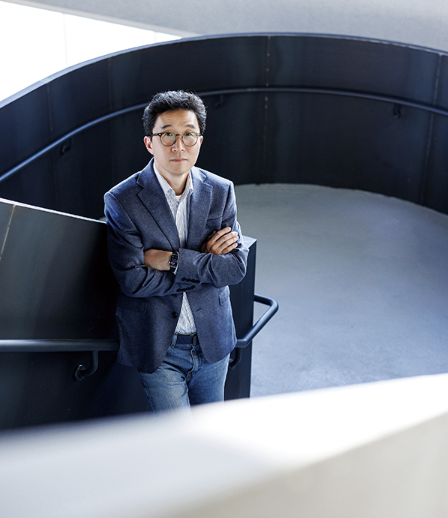
The Republic of Korea is currently engaged in the most critical innovation task: realizing the goal of becoming one of the top three AI powerhouses. To this end, there is an institution carrying out a higher level of leading research. This institution is the National AI Research Lab (NAIRL), launched in October 2024, which serves as a platform to dominate the global AI leadership development and the industry-academia-research AI ecosystem.
Director Kim Kee-Eung, who leads NAIRL, is also a professor at KAIST, actively utilizing domestic and international research networks to set a new milestone for the development of AI in Korea. On November 12, 2025, just over a year after NAIRL’s launch, we met with Director Kim Kee-Eung at the AI Hub in Yangjae-dong, Seoul, to hear about the present and future of AI research and the direction Korea should take.
Director Kim Kee-Eung of the National AI Research Lab (NAIRL) is a core leader who designs the direction of Korea’s original AI technology research. He earned his bachelor’s degree from KAIST, and his master’s and doctoral degrees from Brown University. He built his research career at Samsung SDS and Samsung Advanced Institute of Technology before being appointed as a professor at KAIST in 2006.
Currently, he is leading NAIRL, which involves prominent researchers from KAIST, Korea University, Yonsei University, POSTECH, and leading overseas research teams. The lab focuses on securing next-generation foundational technologies, such as research that transcends the scaling law and robot foundation models. In particular, by establishing a collaborative ecosystem encompassing industry, academia, and research, NAIRL is playing a strategic role in helping the Republic of Korea secure a leading position in the global AI competition.
– Please tell us about the purpose and role of the National AI Research Lab (NAIRL).
The National AI Research Lab is the largest industry-academia-research AI hub in Korea, serving as the nucleus of AI research for the Republic of Korea. It was launched in October 2024 with support from the Ministry of Science and ICT (MSIT) and the Institute for Information & Communications Technology Planning & Evaluation (IITP), as well as cooperation from local governments like Seoul Metropolitan Government and Seocho-gu Office, and 12 private companies. Currently, it has a consortium with four universities—KAIST, Korea University, Yonsei University, and POSTECH—and is conducting various academic research involving 45 domestic professors, 19 overseas professor-researchers, and approximately 250 graduate students from each university.
While various roles are necessary for AI to solidify Korea’s position as one of the world’s top three strong nations, academic research that looks to the future is an extremely important pillar. In this regard, national researchers from abroad, including the United States, Canada, France, and the United Arab Emirates (UAE), reside at NAIRL for a certain period to conduct challenging joint research with domestic researchers. In the future, the lab plans to expand its global cooperation network by holding regular international seminars.
– Please introduce the Director who is leading the National AI Research Lab.
After graduating from KAIST, I completed my Ph.D. in Computer Science at Brown University in the U.S. and was appointed as a professor at KAIST in 2006, where I have continued my research and talent development to this day. I consider myself a person who knows nothing but AI. Among the diverse AI fields, I mainly focus on natural language processing and reinforcement learning.
Reinforcement learning has become quite familiar to the general public since AlphaGo. I was probably the first in Korea to start a regular course dedicated only to that concept. Since opening the reinforcement learning course for KAIST graduate students in 2007, I have consistently pursued research in that area.
– What do you consider the most important factor for enhancing the global competitiveness of the AI ecosystem?
I believe it is ‘talent cultivation.’ While my background as a university professor makes me prioritize talent, one of the more important reasons is that the main agents developing and utilizing AI are ultimately people. Especially in a country like ours, which faces structural problems like population decline, securing talent that forms the foundation of AI competitiveness is even more urgent.
We often hear that companies prioritize AI talent. However, a trend of reducing AI research personnel recruitment also coexists. Abroad, it’s not uncommon for companies to rapidly increase their scale and then downsize again. The AI workforce market is thus a highly volatile and uncertain environment. It is not guaranteed that the current talent shortage will continue five or ten years from now.
Therefore, the talent cultivation plan of NAIRL is not satisfied with what is visible on the surface, but rather to secure AI elites at all levels. To achieve this, we aim to produce many research outcomes by conducting somewhat challenging research.
– In what direction do you believe national-level AI infrastructure should be expanded to promote the private sector?
The AI field is currently very encouraged because the CEO of the ChatGPT website recently announced plans to supply 260,000 Graphics Processing Units (GPUs) to Korea. I hope that this core AI technology infrastructure is also significantly allocated to model research in frontline universities.
The secured GPU supply will likely be primarily used for the clear purpose of developing massive AI models. However, there is definitely a need for a path to provide an environment where university students can freely experiment with various things. In the long run, that could be an even better investment.
There was a past example of this. KAIST was the first university in Korea where the internet was introduced on campus, and at the time, they used national research subsidies to allow students to use the internet freely. However, students used those resources more for games than for research. While it may have seemed like a waste of taxpayer money, later on, based on that experience, founders of department stores, banks, and even global corporate companies emerged. That company is still earning vast foreign currency today.
Whether it is a concern when given or in any other form, it becomes nourishment. Greater achievements can be built upon that experience. From this perspective, I urge the investment of national AI infrastructure into students’ basic research.
– As global AI competition accelerates, what is the path forward for Korean AI governance, and what areas do you think need to be supplemented?
When I talk with overseas AI researchers, they are quite envious of Korea. Even though it’s a thing of the past, countries like France rarely have an ecosystem that covers the entire stack in the AI field, from semiconductors to services. The government’s strong commitment to this also suggests that we can expect synergy between the public and private sectors.
I am confident that the competitiveness of Korean talent is already world-class. Although the number of personnel may be smaller than in the US or China, individual capabilities are on par with the Olympiad level.
However, because the capabilities are so outstanding, there is a structural problem where they tend to leave overseas, and measures to stop this are not easy. Furthermore, I don’t think this should only be viewed from an artificial perspective. Rather, it can be seen from a positive perspective as a good opportunity for Korean talent to compete on the world stage.
While this situation may make us want to avoid and accept the competition, it is a problem that must be solved by better equipping our environment and ecosystem. We need to inspire young elites and attract excellent human resources from developing countries in Southeast Asia. This requires creating a globalized K-research environment so that overseas talent can choose Korea as their career path and actively contribute by settling here.
– It seems that AI talent cultivation has shifted beyond simple technical education to a sense of mission. What competencies do you think future AI talent should possess?
Students who are currently “good” at artificial intelligence are building good careers, but besides that, ethical competence will also be important. If one is to utilize AI well, they must ultimately work by organizing people into teams. Of course, a sense of ethics is important. We must live in a society that coexists with AI, and we need to possess the ability to think one level above AI so that AI provides the right answers.
On the other hand, there is an atmosphere in university research teams these days where students are being asked to use AI instead of professors developing technical prowess, which is robbing them of learning opportunities. This ultimately leads to a decline in the skills of AI society newcomers, which is why I wanted to address it.
The reality is similar now. Some companies are experimentally conducting non-specialist coding tests, including for AI developers, but AI developers are virtually reviewing and correcting the work line by line. However, the possibility of a project to replace AI developers with personnel being realized is very low. If you recall when computers were slow, a similar situation may have existed. Therefore, as time passes and AI technology reaches a stable phase, the situation will change again. I think it is a time when we need to contemplate the method of human-AI collaboration.
– It seems that survival cannot be discussed without AI in all industries and companies now. What advice would you give to companies regarding AI?
It is not impossible to become an AI powerhouse just by securing essential AI infrastructure. Domestic companies have a strong will to adopt AI, but they still lack the capacity to implement it. While large corporations can invest, small and medium-sized enterprises (SMEs) face difficulties in adopting AI due to excessively high entry barriers.
An “AI Divide” between large corporations and SMEs is currently emerging.
The CEO’s word on AI is very important to a company. I don’t think we should only talk about a rosy future for AI right now. CEOs and executive levels first need to understand what AI can and cannot do, and what the most effective way to use AI is, and they also need to provide basic literacy training to their employees. In terms of AI utilization, it is crucial to have not only talent but also dedicated research personnel.
– As a researcher and leader of the National AI Research Lab, what AI fields or directions do you believe Korea must secure over the next five years?
Before being appointed to KAIST, I worked at Samsung SDS, and at that time, the company’s philosophy was ‘AI model integration.’ The chairman himself emphasized his belief that “one strand of AI will feed the entire country.” I consider this an enormous and unique AI vision.
Stanford University’s HLI (Human-Centered AI) research institute ranks countries’ AI performance every year, but Korea is not leading in any of the categories. I found that the framework is not strong enough to be changed every year by the AI model. I believe that these areas must be changed in the future. The quantity of AI fields is not what is important. What matters is seeing which country does AI well and how smart they are. A lot of initial AI investment is happening now, and this field is in a similar context. Our most important goal at NAIRL is to make Korea a hub for attractive talent and build a cooperative ecosystem through this, contributing to securing Korea’s leadership in global AI competition.
