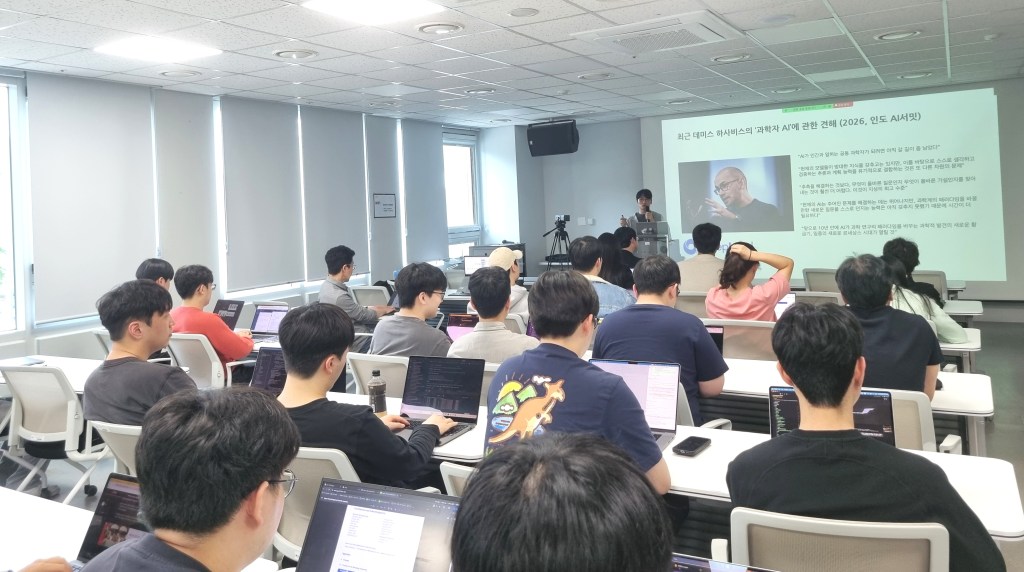
Minhyeong Lee, CEO of Asteromorph, delivers his presentation on "Accelerating Life Evolution with AI," discussing the vision for autonomous scientific systems and the future of the AI Scientist. [Source=NAIRL]
As modern science faces an innovation bottleneck driven by the fragmentation and hyperspecialization of knowledge, Minhyeong Lee, CEO of Asteromorph, shared the potential of the “AI Scientist” to autonomously conduct scientific discovery, as well as future strategies for innovation in the life sciences.
On April 28, the National AI Research Lab (NAIRL) and KAIST Kim Jaechul Graduate School of AI co-hosted a Distinguished Scholar Seminar at the Seoul AI Hub, featuring Minhyeong Lee as the invited speaker. The seminar was held under the theme “Accelerating Life Evolution with AI.” The event drew approximately 290 participants in total, with around 150 attending on-site at the Seoul AI Hub and another 140 joining online.
In his lecture, Lee noted that while existing large language models (LLMs) demonstrate strong performance in solving given conjectures, they still face limitations in open-ended scientific research, where the model must determine what constitutes the right question and which hypotheses are valid. He described the life sciences as a representative field of complex systems, emphasizing that discovering and validating new biological mechanisms within vast bodies of literature and experimental data is a core challenge for the AI Scientist.
Attendees at the Seoul AI Hub listen attentively to the presentation during the Distinguished Scholar Seminar co-hosted by NAIRL and the KAIST Kim Jaechul Graduate School of AI. [Source=NAIRL]
To address this challenge, Asteromorph is developing “Spacer,” a general-purpose scientific reasoning language model. In “Frontier Science Research,” a benchmark designed to evaluate the scientific research capabilities of LLMs, Spacer achieved first-place performance by a significant margin compared to global models such as OpenAI’s GPT-5.2 and Anthropic’s Opus 4.6.
Lee also introduced the direction of Asteromorph’s “Autonomous Scientific System.” The system is a pipeline in which AI generates hypotheses, designs experiments, analyzes data, and iterates through feedback for specific scientific problems. He explained that Spacer is intended to serve as the brain of the Autonomous Scientific System. Through this approach, he noted, AI could go beyond simple paper search or summarization and accelerate scientific discovery through processes closer to actual research workflows.
In particular, Lee distinguished between “Discovery,” which focuses on identifying previously unknown biological mechanisms in the life sciences, and “Invention,” which combines existing knowledge in new ways to create therapeutic strategies or biotechnology methodologies. In the domain of Invention, he explained that AI can explore connections across vast bodies of papers and knowledge systems that human researchers may easily overlook, thereby deriving new methodologies. He further noted that several new disease treatment strategies autonomously proposed by Asteromorph’s AI have already entered the experimental validation stage in collaboration with external medical research institutes.
Minhyeong Lee, CEO of Asteromorph (center), and key attendees from the KAIST Kim Jaechul Graduate School of AI and the National AI Research Lab (NAIRL) pose for a commemorative photo at the Seoul AI Hub during the Distinguished Scholar Seminar. [Source=NAIRL]
The lecture also introduced Asteromorph’s long-term vision, “The Library Project.” The project aims to build and share a large-scale knowledge repository of biological mechanisms autonomously identified by AI. It seeks to extend the kind of transformation brought by Google DeepMind’s AlphaFold DB in protein structure prediction into the domain of biological mechanism understanding.
During the Q&A session, researchers from KAIST and NAIRL raised a range of questions. Participants asked whether AI can autonomously select important research questions, how the innovativeness of AI-generated scientific ideas can be evaluated, and what roles multi-agent structures and data infrastructure play in autonomous scientific systems. Lee responded by sharing concrete perspectives based on Asteromorph’s actual R&D experience and technical approach.
NAIRL plans to continue fostering an ecosystem where domestic researchers can drive both scientific discovery and industrial innovation based on cutting-edge AI technologies, through ongoing exchanges with leading AI researchers, entrepreneurs, and industry leaders from around the world.
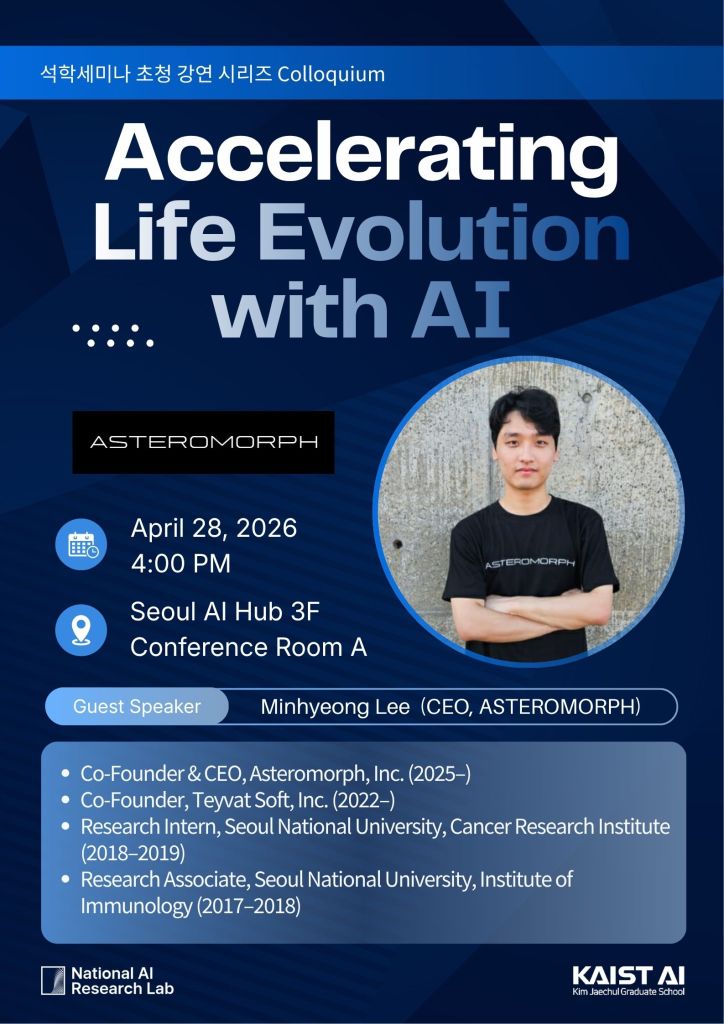
The official poster for the Distinguished Scholar Seminar titled "Accelerating Life Evolution with AI," featuring Asteromorph CEO Minhyeong Lee, co-hosted by the National AI Research Lab (NAIRL) and the KAIST Kim Jaechul Graduate School of AI. [Source=NAIRL]
The Heart of AI Innovation in Korea
108, Taebong-ro, Seocho-gu, Seoul 06764, Republic of Korea
56 Yangjae-daero 12-gil, Seocho-gu, Seoul 06804, Republic of Korea