News
NAIRL and KAIST AI Host Special Lecture by Jeff Dean
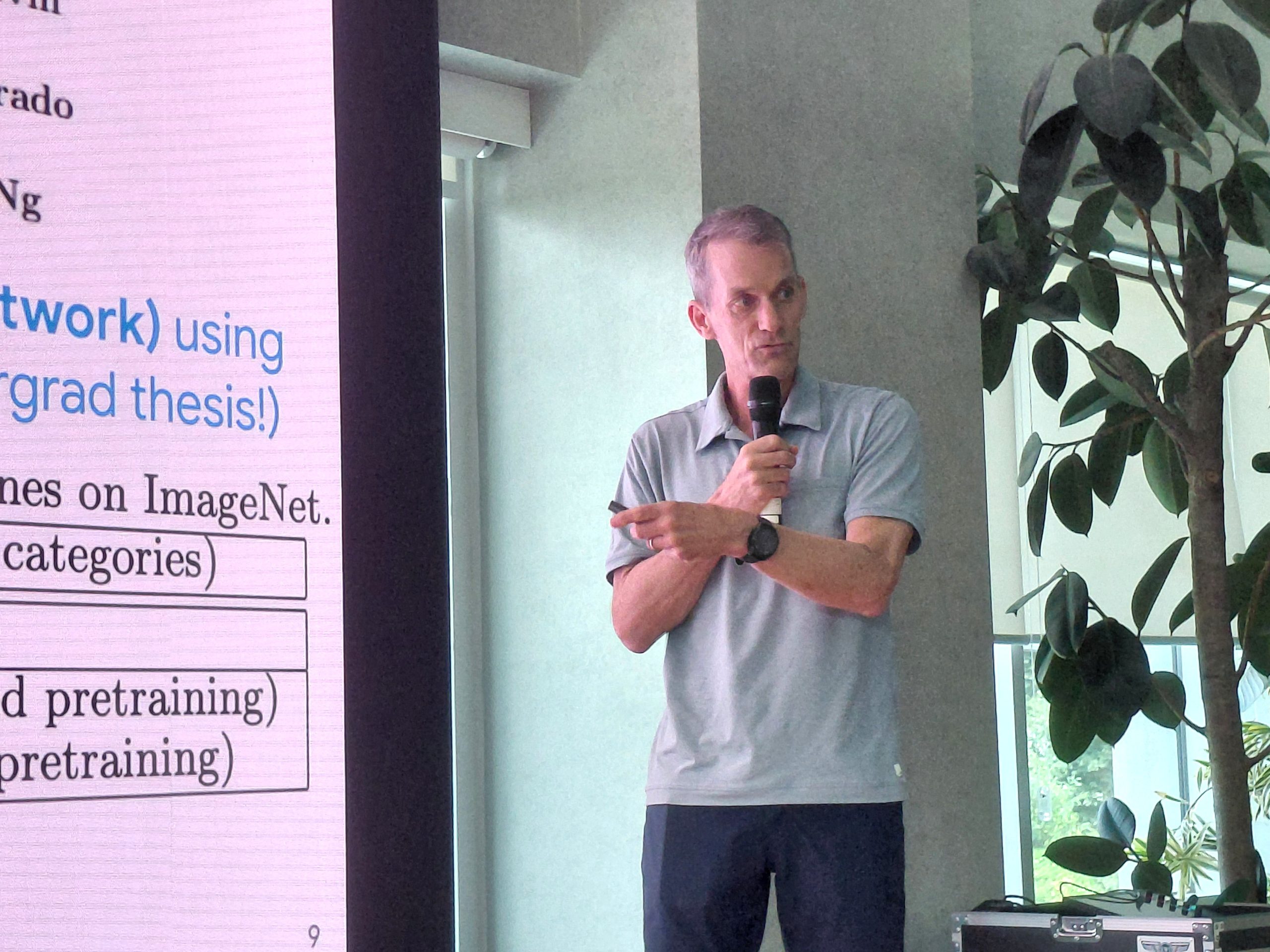
The National AI Research Lab (NAIRL) and the KAIST Kim Jaechul Graduate School of AI hosted a special lecture by Jeff Dean, Co-Founder and CEO of Discovery Loop, at Seoul AI Hub on August 13. The lecture was arranged around Dean’s visit to Korea for his keynote at KDD 2026, the leading international conference in data mining and machine learning, and marked his first public talk since announcing the founding of Discovery Loop.
Dean joined Google in 1999 as one of its earliest employees. Over 27 years, he led the development of MapReduce and Bigtable — the backbone of Google’s search infrastructure — as well as TensorFlow and TPUs, which became foundational to the AI era. He co-founded Google Brain and, as Chief Scientist, oversaw the development of Gemini, earning him a reputation as “the legend of Google.” He recently founded Discovery Loop with Sanjay Ghemawat, Quoc Le, and Oriol Vinyals, with the aim of automating the full experimental loop of research — from forming a hypothesis to running experiments and analyzing results — to accelerate the pace of scientific and engineering discovery itself.
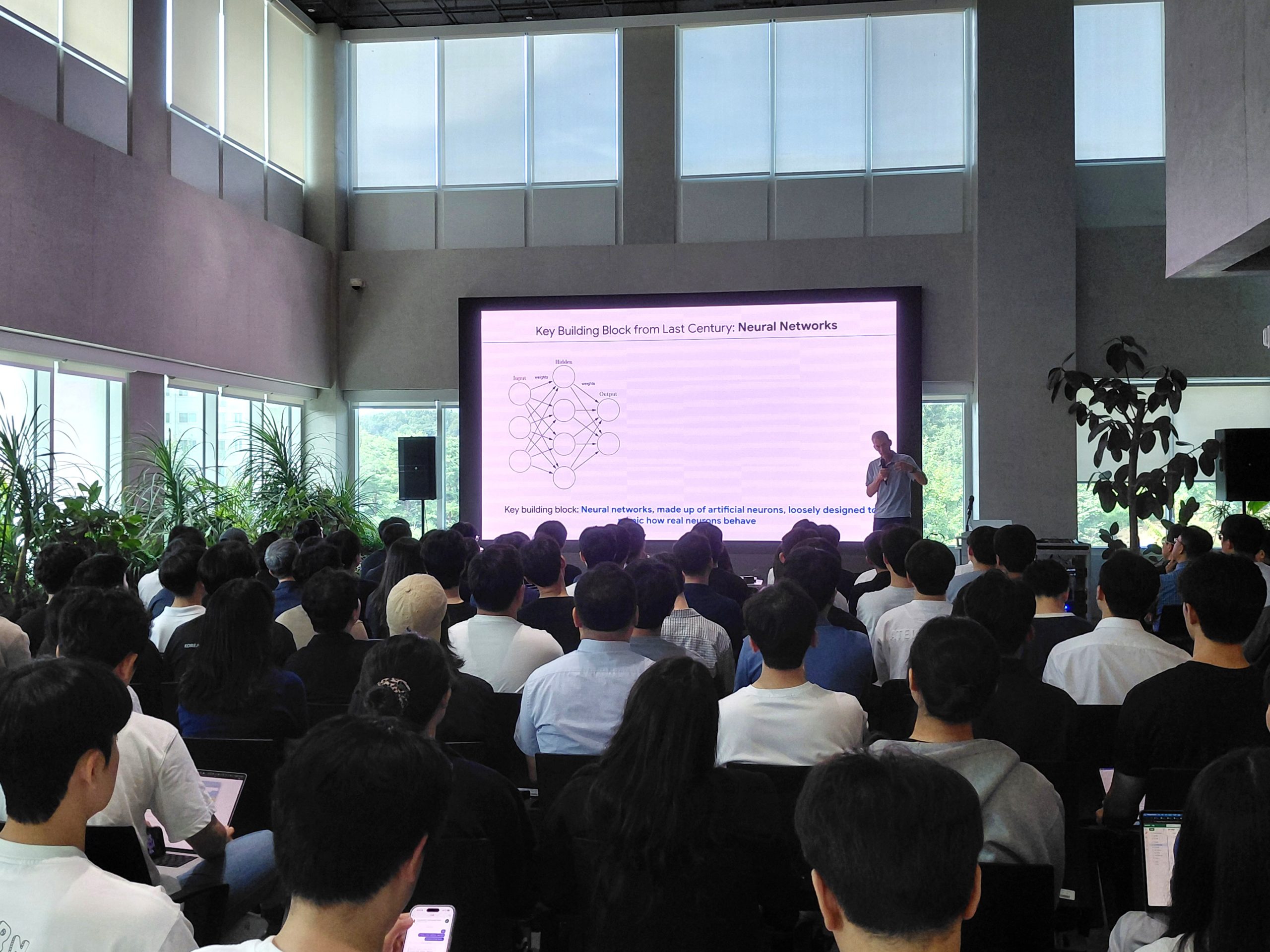
Under the title “Exciting Trends in Machine Learning,” Dean traced the past 15 years of AI through the research he was directly involved in. As an undergraduate in the 1990s, he worked on training neural networks across multiple computers, but the computing power of the time was not enough to make it work. Two decades later, once sufficient compute became available, the same idea finally began to deliver. More computation, more data, and larger models leading to better performance, he explained, has been the consistent through-line of the past 15 years.
He also emphasized the role of hardware. When speech recognition accuracy improved sharply, the team calculated that if users actually began relying on the feature, Google would have needed to double the size of its data centers using existing approaches. That realization led to the development of the TPU, a chip purpose-built for AI computation. Dean noted that the accumulated progress in both hardware and algorithms is what has brought today’s AI models to gold-medal-level performance at the International Mathematical Olympiad (IMO) and the International Collegiate Programming Contest (ICPC).
In the Q&A that followed, participants raised questions on how the spread of coding agents will reshape jobs, how safety can be ensured in autonomous experimental systems, and how equitable access to AI capabilities can be maintained. “When humans and AI work together, we can reach better outcomes than either could alone,” said Dean, framing the relationship as collaboration rather than replacement.
The lecture drew about 150 on-site attendees — faculty and students from KAIST, Korea University, Yonsei University, and POSTECH, the universities of the NAIRL consortium, along with partner company representatives — with another 220 joining via live stream.
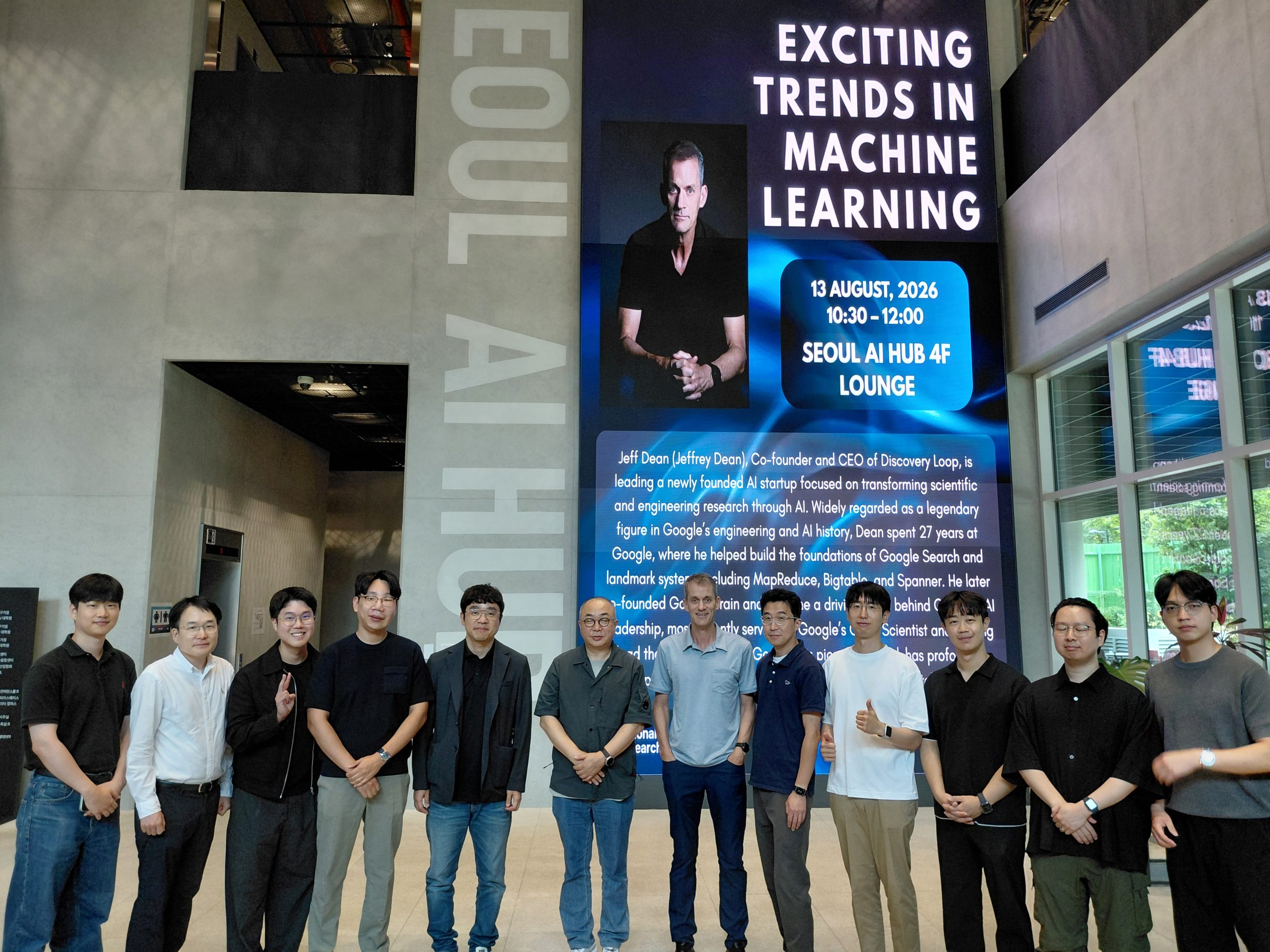
Ahead of the lecture, a pre-talk session introduced the research activities of NAIRL and the KAIST Kim Jaechul Graduate School of AI. Following the lecture, Dean joined a small-group research discussion with faculty and graduate researchers from the KAIST Kim Jaechul Graduate School of AI, offering direct feedback on each lab’s work in areas such as large-scale distributed training and AI infrastructure.
“This was an opportunity for researchers in Korea to hear directly from a legendary scholar who has been at the very front of AI infrastructure and model development for the past 15 years,” said Kee-Eung Kim, Director of NAIRL. “We will continue to expand exchanges with the world’s leading researchers and connect Korea’s AI research ecosystem to the global community.”
NAIRL will continue to broaden exchanges with leading researchers worldwide, strengthening its role in connecting Korea’s research community with the global AI research network.