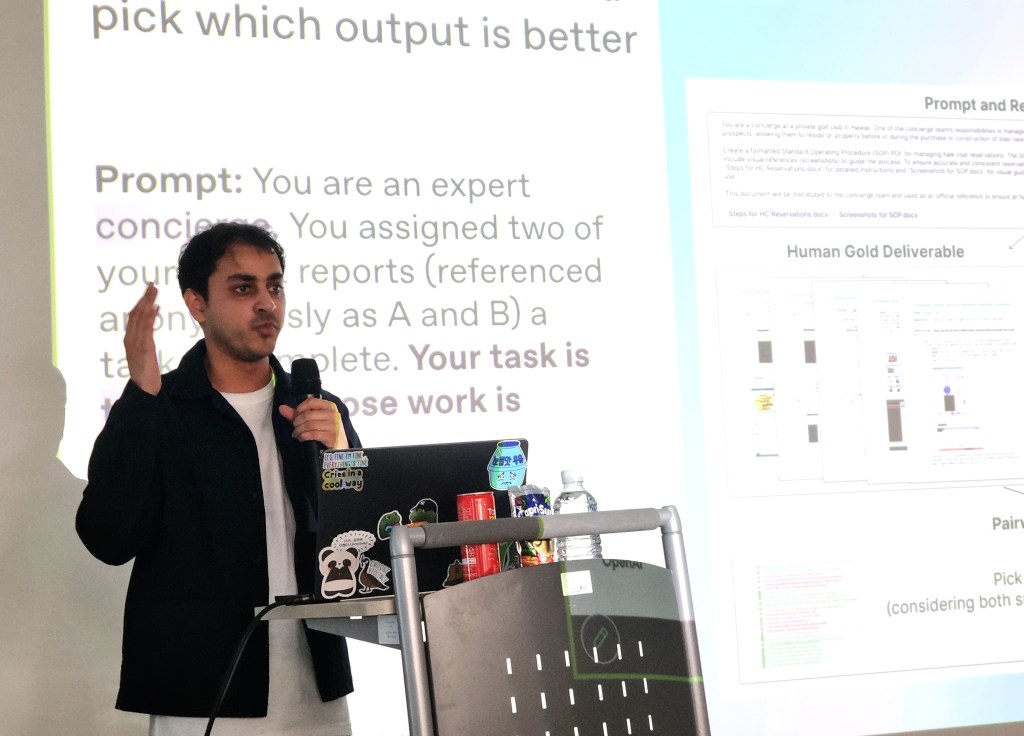
Danial Mirza, Solutions Architect at OpenAI, explains practical evaluation methodologies for frontier AI systems at the Distinguished Lecture Series on March 17. [Source: NAIRL]
As AI models rapidly move beyond research labs into real-world industrial settings and everyday life, OpenAI — a global frontier AI research and deployment company — has shared the insight that new system evaluation criteria are needed, going beyond conventional piecemeal benchmark assessments.
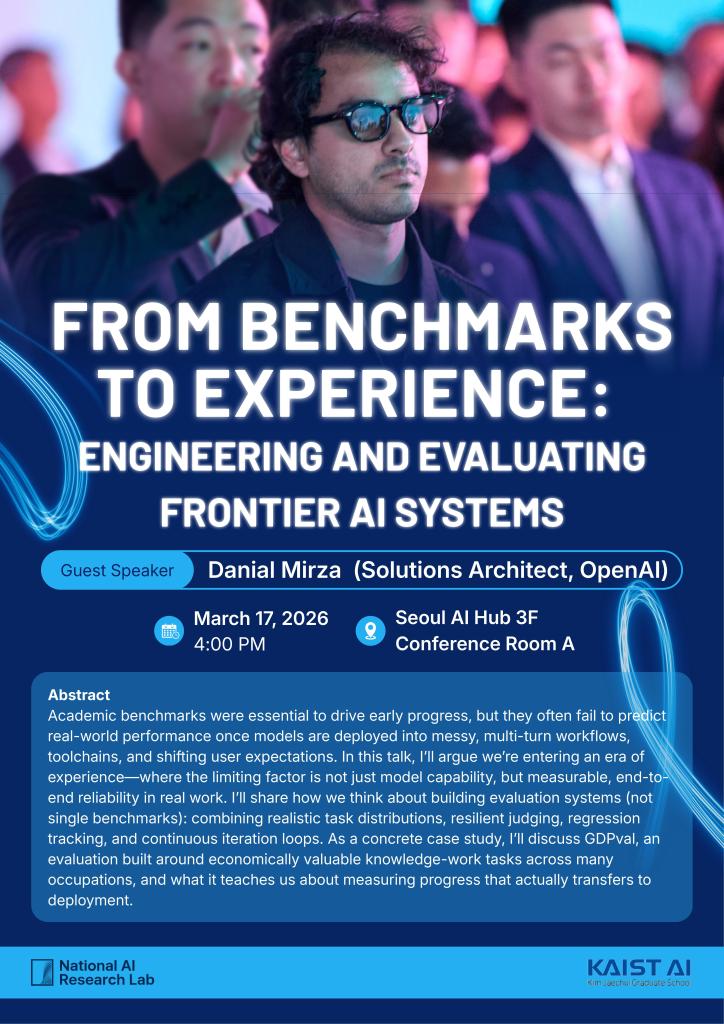
On March 17th, the National AI Research Lab (NAIRL) and KAIST’s Kim Jaechul Graduate School of AI co-hosted a distinguished lecture at the Seoul AI Hub. The event featured Danial Mirza, a Solutions Architect at OpenAI, who spoke on the theme “From Benchmarks to Experience: Engineering and Evaluating Frontier AI Systems.”
Reflecting the high level of interest in frontier AI technologies, the event drew approximately 300 attendees. While 120 KAIST students and researchers participated on-site, another 180 joined online—including 60 researchers and executives from partner organizations—further fueling the enthusiasm for the session.
Attendees actively listening to Danial Mirza's lecture at the Distinguished Lecture Series. [Source: NAIRL]
Mirza noted that while academic benchmarks were essential during the early stages of AI development, their limitations have become increasingly apparent in today’s landscape, where models are deployed in complex, multi-turn workflows and tool-integrated chains. He observed, “We are entering an ‘Era of Experience’ that measures end-to-end reliability in real-world environments, moving beyond a model’s standalone capabilities.”
In particular, Mirza presented OpenAI’s ‘GDPval’ benchmark as a concrete case study. GDPval is an evaluation metric centered on economically valuable knowledge-work tasks across various professions. By combining realistic task distributions, resilient judging criteria, and regression tracking, he emphasized the importance of building systems that measure how a model actually achieves goals in production, rather than just producing plausible-sounding answers.
The presentation was followed by a dynamic Q&A session where KAIST students raised a series of high-level questions. The audience posed insightful inquiries regarding model safety, self-confidence calibration, the limits of synthetic data, and the deployment gaps found in real production environments. Mirza shared generous engineering advice alongside his in-depth responses.
NAIRL plans to continue leading the development of an ecosystem where domestic researchers can thrive at the frontier of AI technology through ongoing exchanges with world-class AI labs and companies.
Official poster for the Distinguished Lecture Series featuring Danial Mirza from OpenAI, scheduled for March 17 at Seoul AI Hub. [Source: NAIRL]
The Heart of AI Innovation in Korea
108, Taebong-ro, Seocho-gu, Seoul 06764, Republic of Korea
56 Yangjae-daero 12-gil, Seocho-gu, Seoul 06804, Republic of Korea