
Research
NAIRL’s Professor Jungseul Ok of POSTECH to Present Two Studies at NeurIPS 2026

A research team led by Professor Jungseul Ok of the Graduate School of Artificial Intelligence at POSTECH, affiliated with the National AI Research Lab (NAIRL), will present two papers at NeurIPS 2026, one of them as an oral presentation. The studies address how a robot should ask questions when a user’s request is ambiguous, and how image generators can follow complex prompts without retraining.
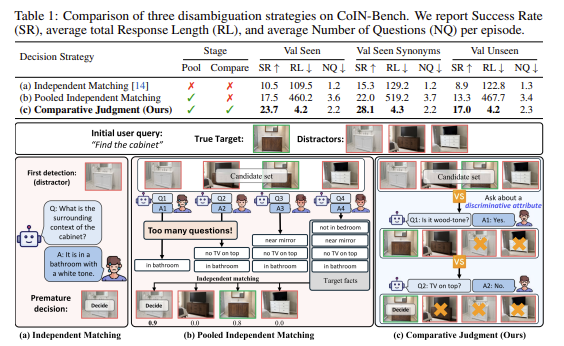
The first study, “ProCompNav: Proactive Instance Navigation with Comparative Judgment for Ambiguous User Queries,” was selected for an oral presentation. When a user asks a robot to find “the cabinet” in a home with several, the robot has to ask follow-up questions. Existing methods are easily misled by similar objects that match the description so far, committing to the wrong target or burdening the user with long answers.
ProCompNav instead gathers a pool of candidates and narrows it through Recursive Comparative Judgment: it picks an attribute that splits the candidates, asks a yes-or-no question, drops the inconsistent ones, and repeats. The method achieved higher success rates with much shorter user responses on CoIN-Bench and the highest success rate on TextNav, and participants in two human studies preferred its interaction style. The study was conducted in collaboration with Oracle.
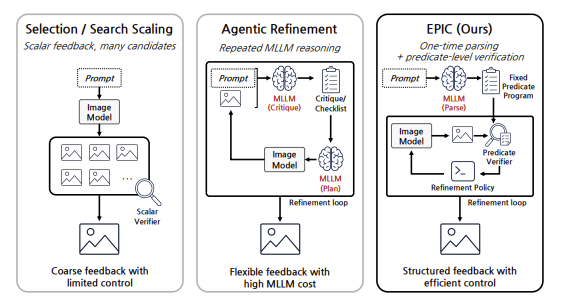
The second study, “EPIC: Efficient Predicate-Guided Inference-Time Control for Compositional Text-to-Image Generation,” tackles a known weakness of text-to-image models, which still struggle with prompts that combine multiple objects, counts, attributes, and relations.
EPIC parses the prompt once into a fixed set of checkable conditions and verifies each generated image against them. Failed conditions decide the next step, sending local errors to targeted editing and global failures to regeneration, all without additional training. On GenEval2, EPIC raised prompt-level accuracy from 34.16 to 71.46 percent and outperformed the strongest prior refinement method by 19.23 points at substantially lower cost.
NAIRL will continue to introduce research that advances the reliability and usability of AI to the broader domestic and international AI community.
ProCompNav: https://arxiv.org/abs/2605.06223 / Project page: https://tree-jhk.github.io/procompnav/
EPIC: https://arxiv.org/abs/2605.11722