Seminar
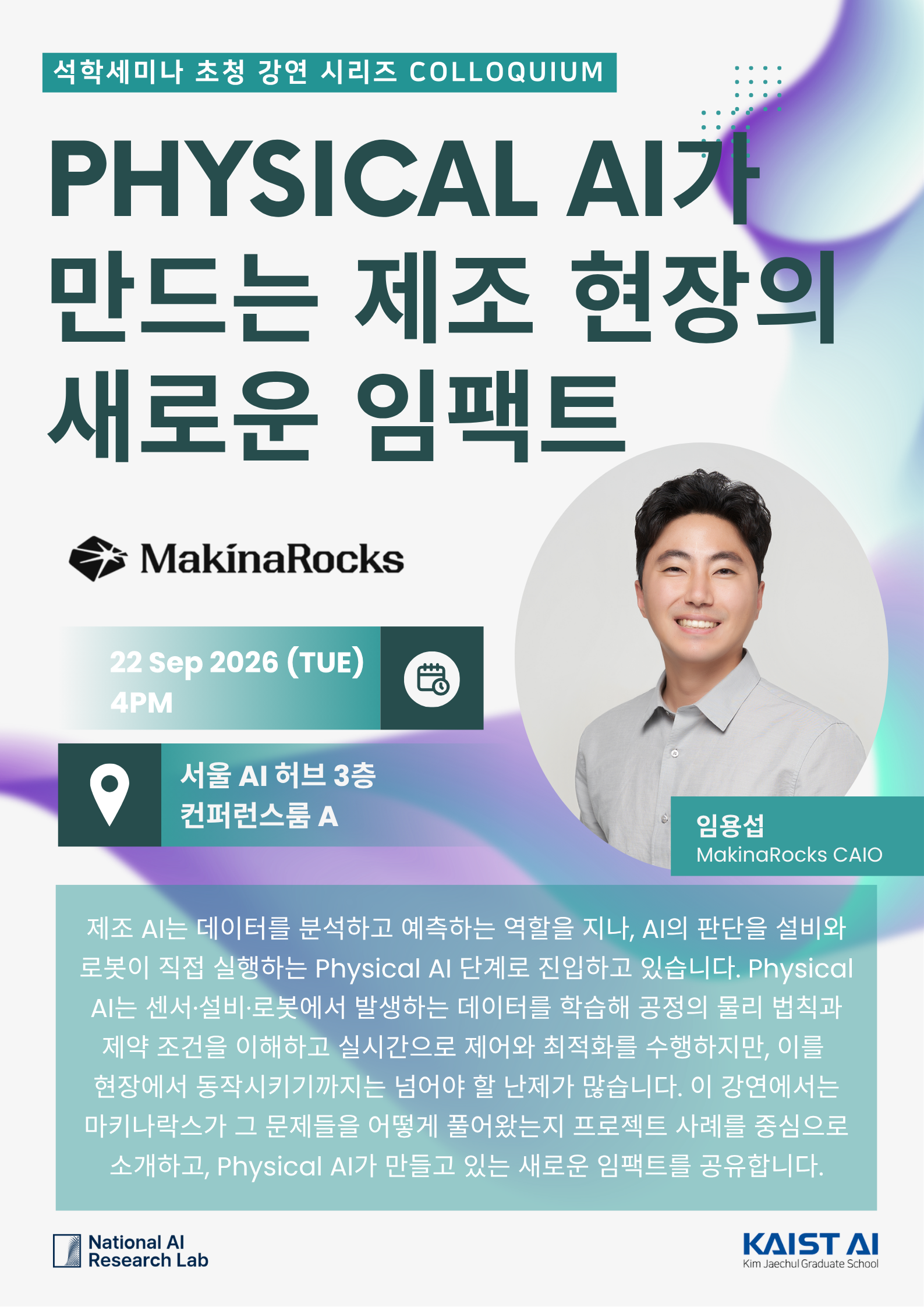
The New Impact of Physical AI on the Manufacturing Floor
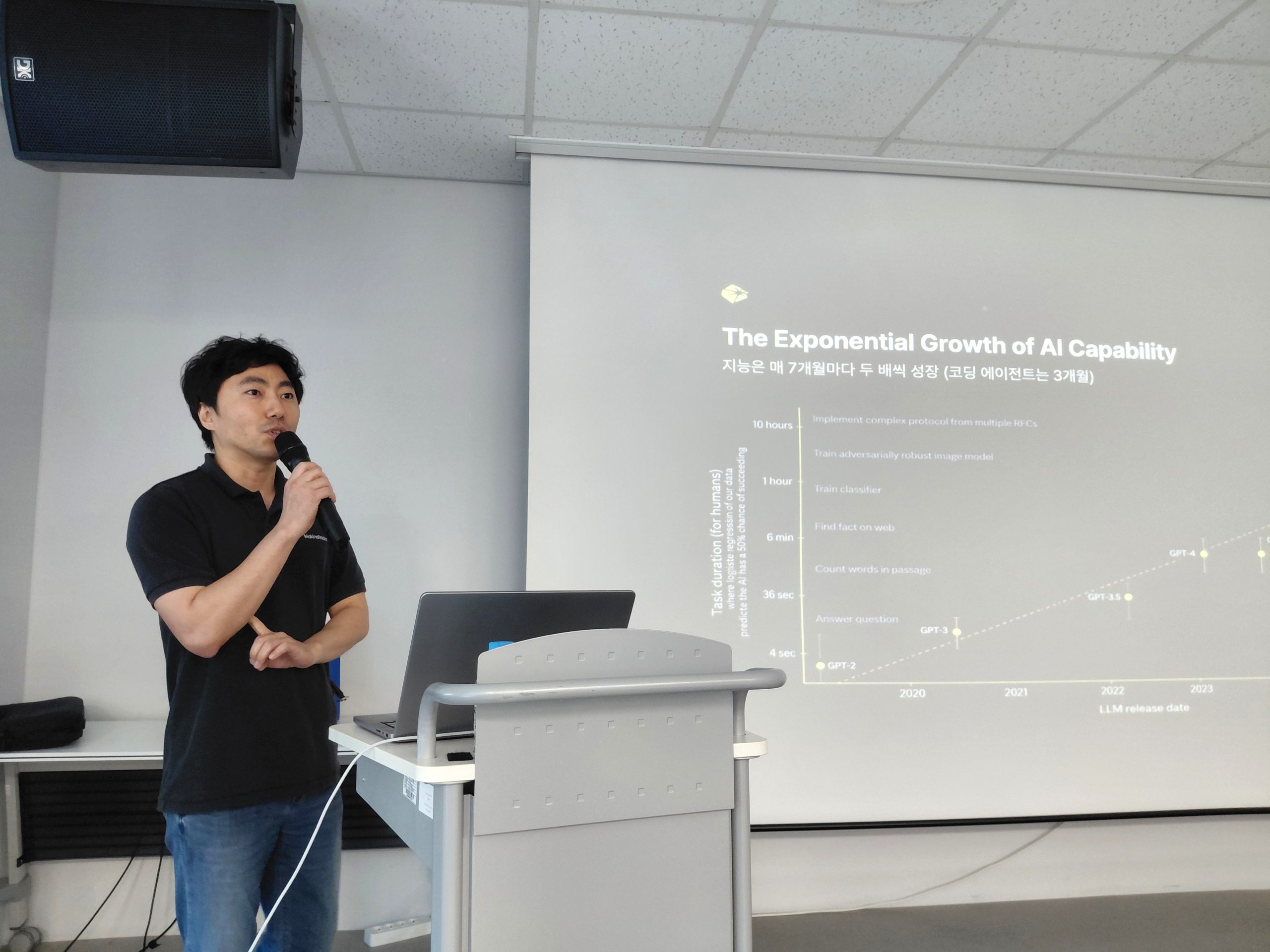
AI capabilities are advancing rapidly, yet their impact at the enterprise and factory level has yet to fully materialize. Yongsub Lim, Chief AI Officer (CAIO) at MakinaRocks, drew on more than eight years of delivering AI to manufacturing sites to explain why industrial adoption is so difficult and to share the project cases through which his company has worked through those obstacles.
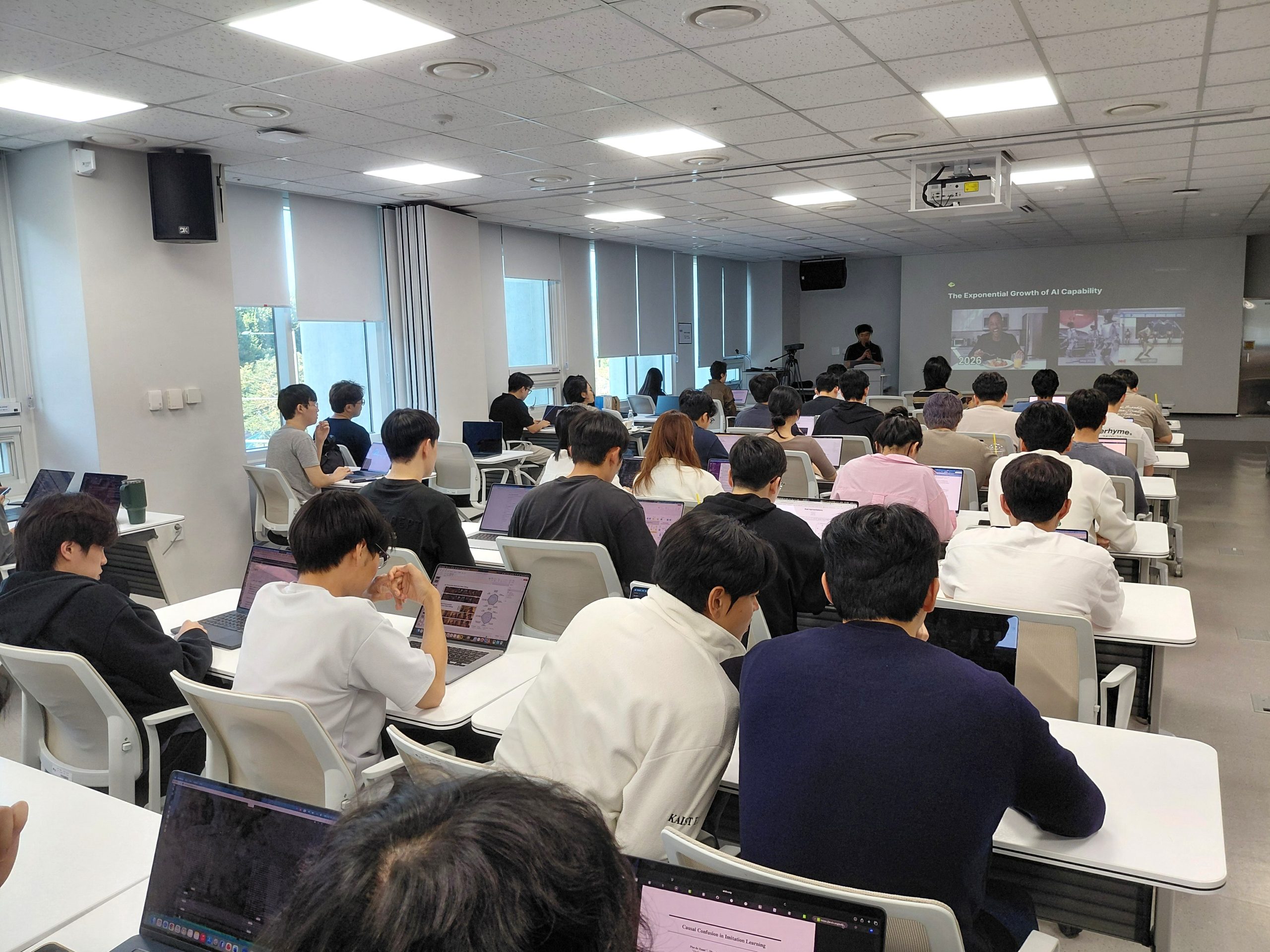
On September 22, the National AI Research Lab (NAIRL) and the KAIST Kim Jaechul Graduate School of AI co-hosted a Distinguished Scholar Seminar at the Seoul AI Hub, featuring Lim as the invited speaker. Held under the theme “The New Impact of Physical AI on the Manufacturing Floor,” the event drew around 300 participants in total, with approximately 150 attending on-site and 150 joining online.
Lim noted that although AI can now complete tasks that would take a human roughly ten hours, most enterprise adoption attempts remain stalled without measurable results. General-purpose language models quickly reach about 80 percent of what a field problem requires, he explained, but closing the gap to the 90 to 98 percent accuracy demanded in production calls for separate work that reflects process environments, physical constraints, and accumulated know-how. Just as even the brightest person cannot walk into a factory and start working on day one, AI cannot create value without knowledge of the site.
The talk unfolded across four pillars: specialized intelligence, digital twins, autonomous control, and the AI operating system. The first case under specialized intelligence was failure prediction for industrial robots on an automotive assembly line. Using autoencoders and generative models to learn normal patterns and quantify deviations, the system automatically produces weekly analysis reports and is now being expanded to more than 1,400 robots. As the growing volume of reports itself became a bottleneck, the team built an LLM-based agent that combines alarm data, past maintenance records, and manuals to help technicians prepare for service calls.
A second case dealt with engineering drawings. By extracting key elements from drawings into a standardized schema and automating similar-drawing search and quoting, the company cut the RFQ response cycle from three to four weeks down to two to three days.
Under digital twins, Lim stressed that because production equipment cannot be freely manipulated for experimentation, data-driven simulators are the starting point for optimization. For an electric vehicle climate control system, a control policy derived from a digital twin and reinforcement learning was deployed on an automotive chip and validated in real-vehicle testing, reducing energy consumption by 10 percent. A steel heat-treatment furnace saw its target temperature achievement rate rise by 9 percent and fuel consumption fall by 3 to 4 percent, while reinforcement learning agents tailored to each operating mode of a waste incinerator increased steam output by 4 percent.
Lim also described a technique that lets the model learn the delay between a control action and its effect on the system. On the difficulty of numerically weighting quality, energy, and stability in reward design, he added that the company is turning to operators’ preference data instead.
Under autonomous control, he introduced an agent that connects to internal systems to automate the full troubleshooting loop on an assembly line, from error detection and root-cause lookup to notifying the responsible engineer and applying the fix, as well as a welding robot that uses 3D cameras to recognize workpieces, plan its own welding path, and carry out quality inspection.
Finally, he argued that operating such AI at enterprise scale requires an AI operating system that handles heterogeneous data integration, model operations and retraining, GPU resource allocation, and the governance and security that have become even more critical in the age of agents, and introduced Runway, MakinaRocks’ productized answer to that need.
NAIRL plans to continue fostering an ecosystem where domestic researchers can drive both scientific discovery and industrial innovation based on cutting-edge AI technologies, through ongoing exchanges with leading AI researchers, entrepreneurs, and industry leaders from around the world.