
Research
Three EMNLP Papers and Two Canadian Internships for NAIRL’s Professor Jong Chul Ye Lab

The research group led by Professor Jong Chul Ye of the Kim Jaechul Graduate School of AI at KAIST, affiliated with the National AI Research Lab (NAIRL), has recorded a series of achievements spanning research output, international placements, and faculty appointment. The lab will present three papers at EMNLP 2026, two of its master’s students have begun funded internships at leading Canadian AI institutes, and one of its graduates will take up a tenure-track position at Korea University.
All three EMNLP papers concern how language models handle external information, two of them in clinical settings.
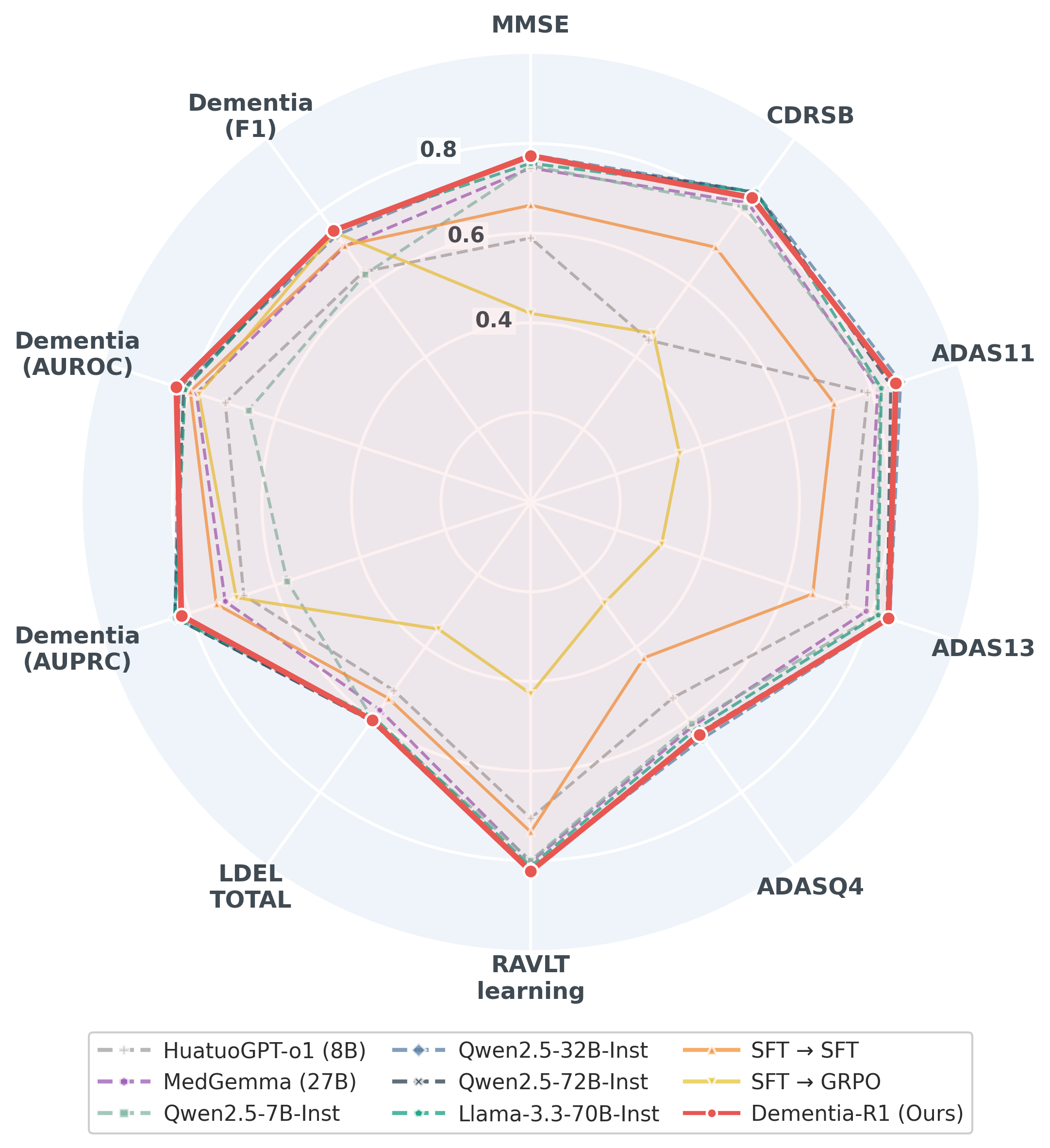
The first, “Dementia-R1: Reinforced Pretraining and Reasoning from Unstructured Clinical Notes for Real-World Dementia Prognosis,” accepted to the main conference, predicts how dementia will progress from the free-text notes clinicians write during consultations. Such prediction requires reasoning across symptom trajectories that rise and fall over many visits, which standard supervised training cannot learn without explicit annotations, and which reinforcement learning struggles with because the rewards are sparse and binary.
The team’s answer was to pre-train the model on verifiable clinical indices drawn from patient histories before asking it to determine the final clinical status. Dementia-R1 reached an AUROC of 84.02 percent on a real-world hospital cohort while outperforming models up to ten times its size, generalized to Parkinson’s disease dementia in an independent cohort at 78.37 percent, and posted the highest AUROC among LLM baselines on the ADNI benchmark at 83.17 percent.
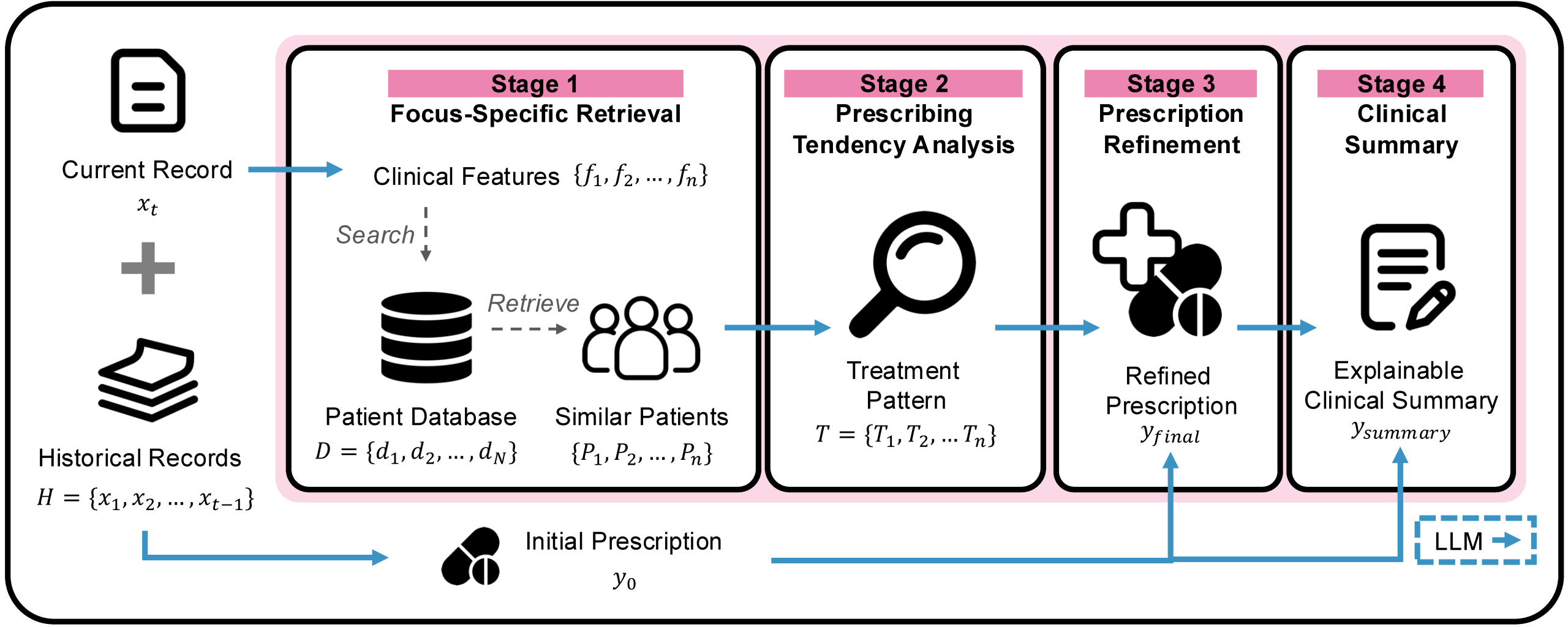
The second paper, “PACE-RAG: Patient-Aware Contextual and Evidence-Constrained RAG for Clinical Drug Recommendation,” accepted to Findings, addresses AI-assisted prescribing. Language models carry broad medical knowledge but miss the fine grain of how clinicians actually prescribe, and existing retrieval methods fall short in two ways: guideline-based retrieval is too generic, while retrieving similar patients tends to reproduce majority patterns and flatten what is distinctive about the individual case.
PACE-RAG combines an individual patient’s context with the prescribing tendencies observed in comparable cases, identifying suitable prescriptions and producing an explainable clinical summary alongside them. Tested on a Parkinson’s cohort and the MIMIC-IV benchmark, it reached F1 scores of 80.84 percent and 47.22 percent respectively.
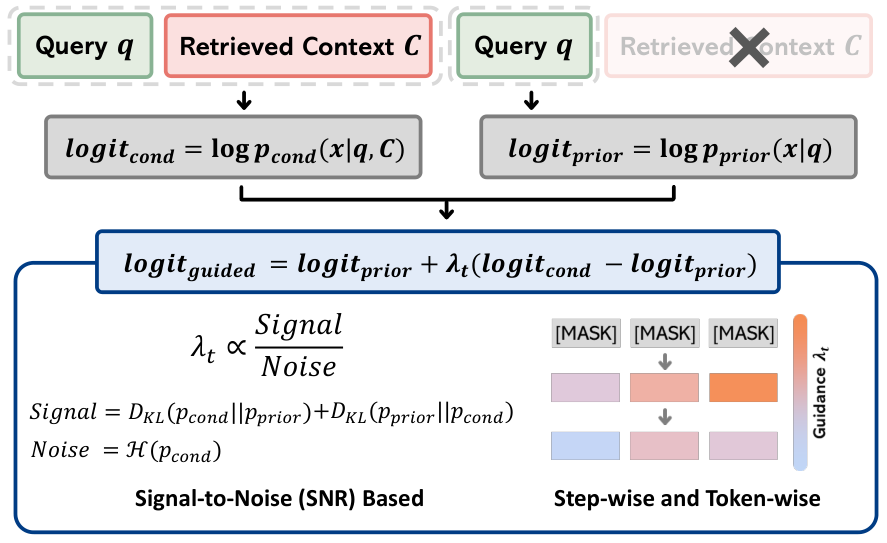
The third paper, “Adaptive Guidance for Retrieval-Augmented Masked Diffusion Models,” also accepted to Findings, asks how much a model should trust what it retrieves. Retrieved context is often noisy or in conflict with what the model already knows, a problem studied in autoregressive models but largely unexamined in diffusion-based ones, where generation proceeds through iterative denoising.
The team’s framework, ARAM, requires no additional training and adjusts the guidance scale at each denoising step according to the signal-to-noise ratio of the shift the retrieved context induces, strengthening guidance when the evidence is reliable and suppressing it when the signal is noisy. Across five knowledge-intensive QA benchmarks, ARAM improved on competitive RAG baselines.
Alongside this research output, two master’s students from the lab have begun funded research internships in Canada. Jeongjae Lee is at Mila, the Quebec AI Institute founded by Yoshua Bengio, and Jonghyun Park is at the Vector Institute in Toronto, co-founded by Geoffrey Hinton. Both internships are fully funded by the host institutes.
The lab has also seen one of its graduates move into a faculty position. Hyungjin Chung, who completed his doctorate in February 2025, will join Korea University as an Assistant Professor in the fall of 2026. Korea University is one of the four universities that make up the NAIRL consortium, alongside KAIST, Yonsei University, and POSTECH.
NAIRL will continue to introduce both the research achievements and the people emerging from its participating institutions to the broader domestic and international AI community.
Dementia-R1: https://arxiv.org/abs/2601.03018
PACE-RAG: https://arxiv.org/abs/2603.17356
Adaptive Guidance: https://arxiv.org/abs/2603.17677