
Research
NAIRL’s Professor Hae-Gon Jeon to Present at ECCV 2026 and in IJCV
A research team led by Professor Hae-Gon Jeon of the Department of Artificial Intelligence at Yonsei University, affiliated with National AI Research Lab (NAIRL), will present research achievements at the European Conference on Computer Vision (ECCV 2026) and in the International Journal of Computer Vision (IJCV). The studies tackle two questions: how to make AI write naturally like a human hand, and how to reliably reconstruct and edit 3D scenes even when the lighting keeps changing.
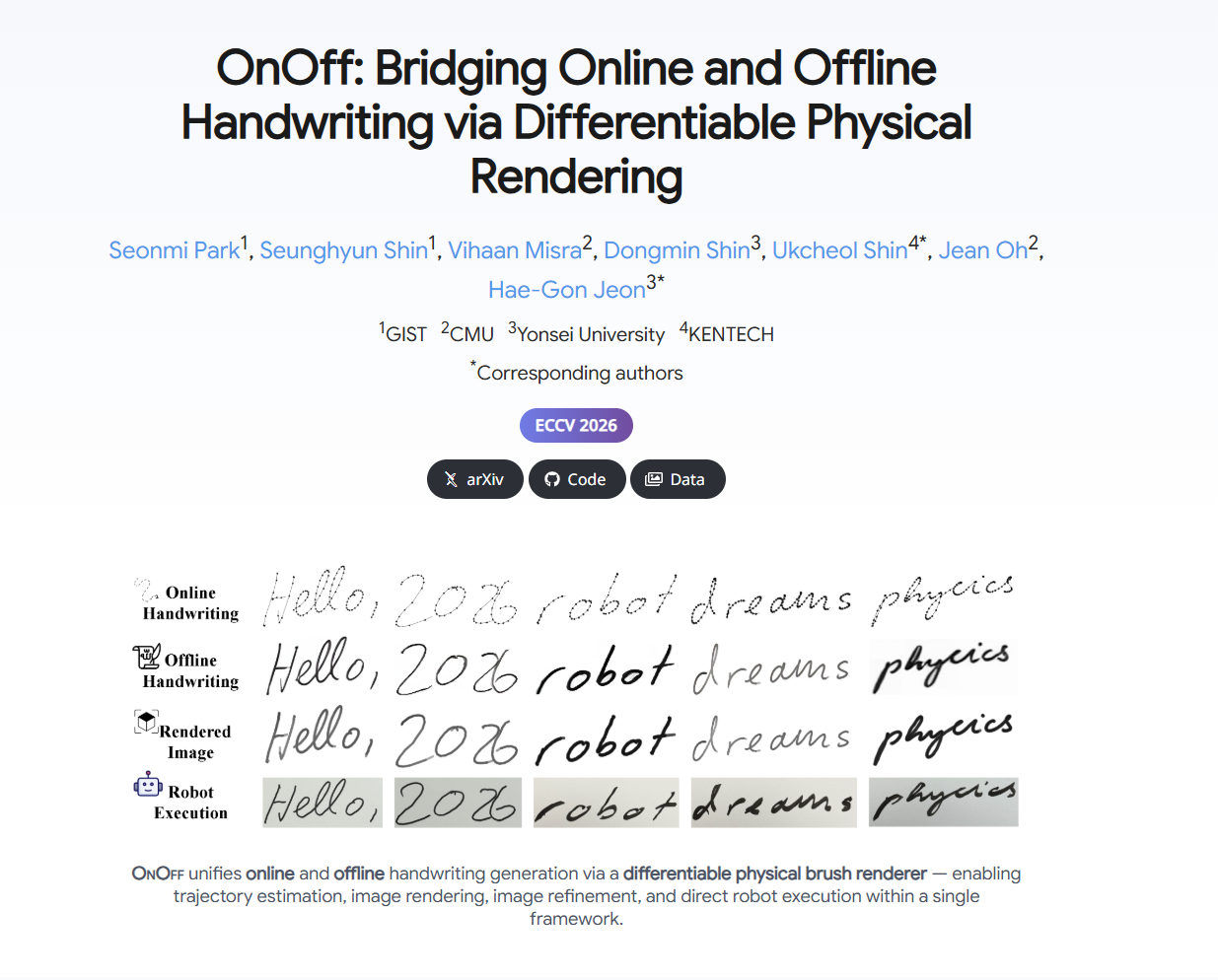
The first study, “Bridging Online and Offline Handwriting via Differentiable Physical Rendering,” will be presented at ECCV 2026. AI handwriting has long been split into two camps: models that capture how a pen moves as it writes, and models that draw the finished appearance of the writing as an image. Because the two developed separately, connecting pen motion to the final written form remained difficult.
The team closed this gap with a physical brush model that mimics how a real brush leaves strokes as it moves across paper. Feed in a pen’s motion, and the framework computes the exact written image that motion would produce. Given only text, it generates the stroke movements, renders them into an image, and refines the result in a single pipeline, and its fidelity was demonstrated in robotic calligraphy, where a robot arm physically writes with a brush. The study was conducted as an international collaboration with researchers at GIST, the CMU Robotics Institute, and KENTECH.
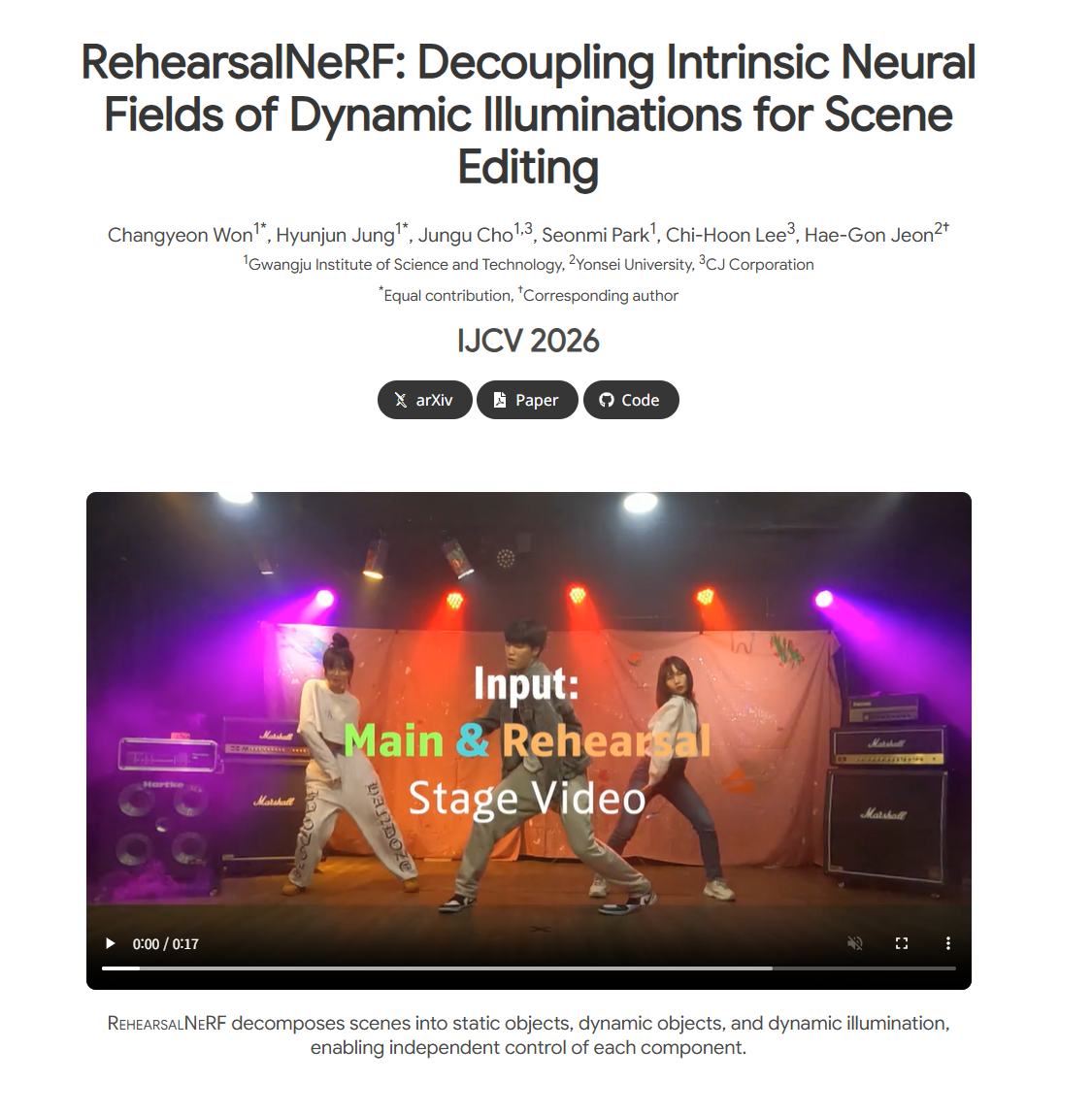
The second study, “RehearsalNeRF: Decoupling Intrinsic Neural Fields of Dynamic Illuminations for Scene Editing,” will be published in IJCV 2026, a leading journal in computer vision. Neural radiance fields (NeRF), a technology that reconstructs 3D spaces from photos and videos, has advanced rapidly, but it breaks down in settings like concert stages where the lighting constantly changes. The AI cannot tell whether the color it sees is an object’s true color or an effect of the lighting, leaving the reconstruction unstable.
The team found its answer in the rehearsal before the show. Using footage captured in advance under steady rehearsal lighting as a reference, the AI learns to separate an object’s true colors and shapes, the lighting effects, and the people moving on stage. As a result, the method produces stable new viewpoints even from footage flooded with stage lighting, and enables scene editing such as changing or removing the lights altogether.
These achievements are meaningful in that they lay foundational technologies for generative AI and 3D visual intelligence to be deployed in real-world settings such as robotics and content creation. NAIRL will continue to introduce research that expands the expressiveness and reliability of AI to the broader domestic and international AI community.
Paper: https://arxiv.org/abs/2608.03198 / Project page: https://seonmip.github.io/onoff/
RehearsalNeRF: https://link.springer.com/article/10.1007/s11263-026-02816-0 / Project page: https://wcy199705.github.io/RehearsalNeRF/